<?xml version="1.0" encoding="utf-8"?><feed xmlns="http://www.w3.org/2005/Atom" ><generator uri="https://jekyllrb.com/" version="4.3.3">Jekyll</generator><link href="https://log.silentcomics.com/feed.xml" rel="self" type="application/atom+xml" /><link href="https://log.silentcomics.com/" rel="alternate" type="text/html" /><updated>2024-07-25T11:17:42+00:00</updated><id>https://log.silentcomics.com/feed.xml</id><title type="html">Frame by Frame</title><subtitle>SILENT COMICS log.</subtitle><entry><title type="html">The Need For Speed</title><link href="https://log.silentcomics.com/tools/design/slow-speed/" rel="alternate" type="text/html" title="The Need For Speed" /><published>2020-12-12T00:00:00+00:00</published><updated>2020-12-12T00:00:00+00:00</updated><id>https://log.silentcomics.com/tools/design/slow-speed</id><content type="html" xml:base="https://log.silentcomics.com/tools/design/slow-speed/"><![CDATA[<p>People often talk about comics as an industry, the comics industry, but that sounds wrong somehow. If it is an industry, then it is one unlike any other. First, the so-called information age changed the way we design books. The combined effects of image-making software and the internet made producing and distributing a comic book accessible to anyone.
Yet, aside from the studio method, making a comic book is still a lonely, artisanal craft. Designing comics alone is slow, despite new tools. Throw perfectionism into the mix, and drawing comics will take ages. You can find several comic pages, attempts, and ideas in my drawers. Some have been there for years. Spending most of my time working for clients slows my occasional progress even more. Then, interruptions and the absence of visible progress affect my motivation too. To draw a somewhat ambitious comic book, the line between making slow progress and postponing everything can get thin. On the positive side, I have many ideas for (long-form) stories to illustrate. The problem is finding time to work on them. There are no excuses. For this project to bear fruits, the question becomes: how can I speed up comic book making?</p>

<h2 id="forsake-perfectionism">Forsake perfectionism</h2>

<p>The first step is to deal with perfectionism. If you think about it, being a perfectionist about comics-making is ridiculous. There are major world crises and pressing problems that require immediate attention. Thinking about comics is in itself a luxury. True. Then again, if you are going to do anything, you should do it to the best of your abilities. Otherwise, why bother? The problem with this thinking is that it leads to delay, and delay leads to creative paralysis. One should break this cycle.</p>

<p>One shouldn’t aim at perfection. Try to focus on an efficient drawing style instead.</p>

<p>Simplify. Then simplify even more, but beware of simplification itself. Any attempt to get perfection will lead to more perfectionism.</p>

<h2 id="draw-in-tiny-frames">Draw in tiny frames</h2>

<p>On top of sheer speed, the advantage of drawing small is accuracy. Tiny sketches are often powerful and more accurate than large drawings. You can draw smaller to create storyboards faster.</p>

<p>The point is being fast. You could draft your entire story in less than one month. Think about it. Use small drawings—by the thousands if need be. That way, you can explore a story from many angles and pick the one that best fits a sequence. It forces you to concentrate on the whole without getting lost in details. All this allows you to quickly test different visions of the same scene and see which would work better. Small storyboards help you structure a strong composition. Thumbnail drawings are your secret weapon.</p>

<p>To gain something, you often have to sacrifice something else. When you draw at a small scale, your arm is not working as a whole, shoulder included. The drawing result can become intricate and messy. Too many details will not fit in a small drawing. Compensate this by concentrating on proportions, accuracy, dynamism, and general composition. In the second pass, you can trace over your enlarged initial sketch to add details. Scan and print out at a higher resolution if you are working with traditional drawings.</p>

<h2 id="sketches-as-final">Sketches as final</h2>

<p>Chiseled work tends to lack essence. That is a common concern for many illustrators: the draft is better than the finished piece!</p>

<p>To keep the energy of your initial sketches in the final piece, enlarge the drawings and redraw over. You can draw and discard rough sketches fast, like notes, without worrying if the page looks unfinished. Many people love rough sketches precisely for their raw, unpolished quality. Keep in mind: a high level of polish hardly matters as much as your ability to tell a story. When you overdo a drawing, it looks stiff; I prefer lively sketches over polished pieces anytime. Genuine drawing skills beat tracing over photographs in my book. Complete the first draft to get your point across. You could even tell the whole story in that form.</p>

<p>This first version lets you judge what needs to change. What’s needed now? A few refinements or even a complete makeover?</p>

<h2 id="skip-penciling">Skip penciling</h2>

<p>Ink everything directly on the page to work faster. I like to draw in multiple passes, over and over, until I am happy with an illustration. Tracing paper is my friend. Unfortunately, the beauty and life of the initial sketch usually get lost in the process. Keeping the primal energy of the first sketches is always a challenge. Redrawing passes is also time-consuming and inefficient. Inking directly on the page is an answer to that problem. If you still need a blueprint, ink, or paint over the rough sketches.</p>

<p>You could also do without penciling and coloring:  skip that or make it an integral part of the final art.</p>

<h2 id="skip-colors">Skip colors</h2>

<p>If you are drawing a comic book, chances are that coloring is slowing you down. Being a good colorist is a skill worthy of a separate profession. Now, you could skip coloring artwork. Black and white comics are great. However, removing the color stage means abandoning a powerful narrative device. You could also decide to use a single color or a reduced palette.</p>

<p>In the end, it is all about choice.</p>

<h2 id="skip-lettering">Skip Lettering</h2>

<p>Lettering is another time-consuming task. It may be worth spending time to design a custom hand-lettered font, an investment upfront that will save so much time later. Fortunately, it is only relevant to a story with dialogues. Their title aside, wordless comics have no use for much lettering.</p>

<h2 id="skip-writing-a-script">Skip writing a script</h2>

<p><strong>Make the comic itself become the script.</strong> If you are in a hurry, start drawing without a story. Make it all up. Draw the comic as a rough storyboard. Still readable, it has aesthetic qualities in itself. It’s a visual script that contains the story. It might stand up as it is, not as a finished, over-designed book, but as an original blueprint. You might spend ages turning it into a fine art book later on. But at least you’ll have both the comic and the story, not just a vision in your head.</p>

<h2 id="design-stories-as-visual-narratives">Design stories as visual narratives</h2>

<p>The above point is an excellent start to avoid perfectionism and get started fast, but replacing a written script with pictures or a storyboard is also a viable approach to storytelling. Miyazaki adopted this strategy to create the story of Ponyo. Instead of beginning with writing a screenplay, he started with mood boards. His visuals only began forming a cohesive story afterward. Other authors were successful with this strategy: Hergé worked like that for a while on serial strips published in newspapers, not knowing exactly where the story was going. This approach lets you avoid becoming entangled with a script. You could go wrong or right either way. Comics is a visual medium, and drawing is a legitimate way to tell a story.</p>]]></content><author><name>SILENT COMICS</name><uri>https://silent-comics.com</uri></author><category term="tools" /><category term="design" /><summary type="html"><![CDATA[Drawing comics, fast and slow]]></summary></entry><entry><title type="html">OKΠ</title><link href="https://log.silentcomics.com/characters/OKpi3.14/" rel="alternate" type="text/html" title="OKΠ" /><published>2017-02-03T00:00:00+00:00</published><updated>2017-02-03T00:00:00+00:00</updated><id>https://log.silentcomics.com/characters/OKpi3.14</id><content type="html" xml:base="https://log.silentcomics.com/characters/OKpi3.14/"><![CDATA[<p><img src="/characters/OKpi314.svg" /></p>

<figure>
	<a href="/images/OK_pi-1.jpg"><img src="/images/OK_pi.jpg" /></a>
	<figcaption> OKΠ</figcaption>
</figure>

<figure>
	<a href="/images/OK_pi-1.jpg"><img src="/images/OK_pi-1.jpg" /></a>
	<figcaption> OKΠ</figcaption>
</figure>

<figure>
	<a href="/images/OK_pi-1.jpg"><img src="/images/OK_pi-2.jpg" /></a>
	<figcaption> OKΠ</figcaption>
</figure>

<figure>
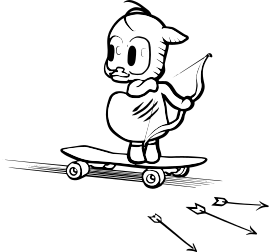
<img src="/characters/OKpi314.svg" />
<figcaption>SGV figure — OKpi 3.14 / OKΠ</figcaption>
</figure>

<div><a href="https://silentcomics.com/Silent-Comics-Project-Progress-Graph.html" class="btn btn--info">progress .txt</a></div>

<p><a href="http://eepurl.com/RxmEn" class="btn btn--success">Sign up for early launch</a></p>]]></content><author><name>SILENT COMICS</name><uri>https://silent-comics.com</uri></author><category term="[&quot;characters&quot;]" /><category term="OKΠ" /><category term="SILENT COMICS" /><summary type="html"><![CDATA[SILENT COMICS characters: OKΠ.]]></summary></entry><entry><title type="html">Two kinds of quality</title><link href="https://log.silentcomics.com/design/Two-kinds-of-quality/" rel="alternate" type="text/html" title="Two kinds of quality" /><published>2016-09-08T00:00:00+00:00</published><updated>2016-09-08T00:00:00+00:00</updated><id>https://log.silentcomics.com/design/Two-kinds-of-quality</id><content type="html" xml:base="https://log.silentcomics.com/design/Two-kinds-of-quality/"><![CDATA[<p>The Japanese language has two words to describe quality: <em>atarimae hinshitsu</em> and <em>miryokuteki hinshitsu</em>.</p>

<h2 id="atarimae-hinshitsu当たり前品質">atarimae hinshitsu　（当たり前品質）</h2>

<p>A quality that is inherent to an object. Atarimae hinshitsu roughly translates as ”taken-for-granted quality”.</p>

<p>The idea that things should work as they are supposed to. There is an elegance of things working according to their function. For example, a pen should help you write, and a wall has a functional role in the house as a product. When something works according to its functionality, it meets the “atarimae” quality expectation. In this spirit, reliability and robustness should be a part of atarimae hinshitsu.</p>

<h2 id="miryokuteki-hinshitsu-魅力的品質">miryokuteki hinshitsu （魅力的品質）</h2>

<p>A “charming”, “bewitching” or “enchanting quality.” This kind of quality appeals to a person’s aesthetic sense of beauty and elegance rather than to customer expectations and reliability.</p>

<p>The idea that things should have an aesthetic quality, different from “atarimae hinshitsu”. This disposition goes beyond functional requirements. e.g. a pen will write in a way that is pleasing to the writer, and leave behind ink pleasing to the reader. In the wall example, color, texture, shine, polish, etc., are the “miryokuteki” aspects. These aspects form an important part of the overall quality and bring added value to the product.</p>

<p><em>In goods or services design, atarimae hinshitsu and miryokuteki hinshitsu together ensure that a creation will both meet customers’ expectations and be desirable to have.</em></p>

<p>Quality<sup id="fnref:1" role="doc-noteref"><a href="#fn:1" class="footnote" rel="footnote">1</a></sup> reflects a philosophy, just as language does and it is no surprise that the Japanese see quality as a combination of function and form.</p>

<p class="notice">Source: <a href="https://startupclass.co/courses/how-to-start-a-startup/lectures/64036">Kevin Hale — How to Build Products Users Love</a></p>

<div class="footnotes" role="doc-endnotes">
  <ol>
    <li id="fn:1" role="doc-endnote">
      <p>Wikipedia, “Eight dimensions of quality” <a href="https://en.wikipedia.org/wiki/Eight_dimensions_of_quality">https://en.wikipedia.org/wiki/Eight_dimensions_of_quality</a> <a href="#fnref:1" class="reversefootnote" role="doc-backlink">&#8617;</a></p>
    </li>
  </ol>
</div>]]></content><author><name>SILENT COMICS</name><uri>https://silent-comics.com</uri></author><category term="[&quot;design&quot;]" /><category term="quality" /><summary type="html"><![CDATA[Japanese has two words to describe quality: 当たり前品質 and 魅力的品質.]]></summary></entry><entry><title type="html">Wordmark</title><link href="https://log.silentcomics.com/design/typography/Wordmark/" rel="alternate" type="text/html" title="Wordmark" /><published>2015-08-21T00:00:00+00:00</published><updated>2015-08-21T00:00:00+00:00</updated><id>https://log.silentcomics.com/design/typography/Wordmark</id><content type="html" xml:base="https://log.silentcomics.com/design/typography/Wordmark/"><![CDATA[<figure>
<img src="https://silentcomics.com/SC_LOGO.svg" />
<figcaption>SILENT COMICS wordmark.</figcaption>
</figure>

<h2 id="a-wordmark">A wordmark</h2>
<p>Writing a name is one of the most basic forms of branding. Whereas a logo is a graphic mark, an emblem or a symbol, which can include letters and various typefaces, a wordmark is a typographic treatment of a name. In short, a wordmark is a logo but a logo is not necessarily a wordmark. It makes sense that an image-only project like SILENT COMICS would get its own text-only type of logo.</p>

<h2 id="futura">Futura</h2>
<p>For SILENT COMICS I was looking for a typeface evocative of the silent films era but still looking current. There are plenty of inspiring letter types from that time, in particular posters and title cards hand-drawn letters. But the simplicity and timeless elegance of Futura are unmatched. A geometric typeface designed by <a href="https://en.wikipedia.org/wiki/Paul_Renner">Paul Renner</a> and released in 1927, Futura has arguably been overused. You can spot it everywhere: in movies, signage and corporate literature. It also served as the basis for countless logotypes. Rather than a problem, I see its success as a reminder that modernity is built from the past. Modernity can and in fact should go hand in hand with long-lasting quality. The SILENT COMICS logo uses Futura Book. Aside from its name, it has little visual connection with comics. That is good, I like the quiet, ordered feel of restraint it has now, which contrasts with the subject matter.</p>

<h2 id="simplicity">Simplicity</h2>
<p>Besides kerning, the only addition to the letters is two horizontal lines, above and below the name. They stand for the (comics) frame, giving the ensemble a bit more stability. Notice how it is open on the sides. At some point, I added a triangle underneath to suggest a comic book balloon. Then decided against it: too decorative. Plus, there won’t be any balloons in this project. I like what Raymond Poïvet<sup id="fnref:1" role="doc-noteref"><a href="#fn:1" class="footnote" rel="footnote">1</a></sup> had to say about comics: (in French) “Bande dessinée” means “drawn strip”.</p>

<p>And that’s all there is to it.</p>

<figure>
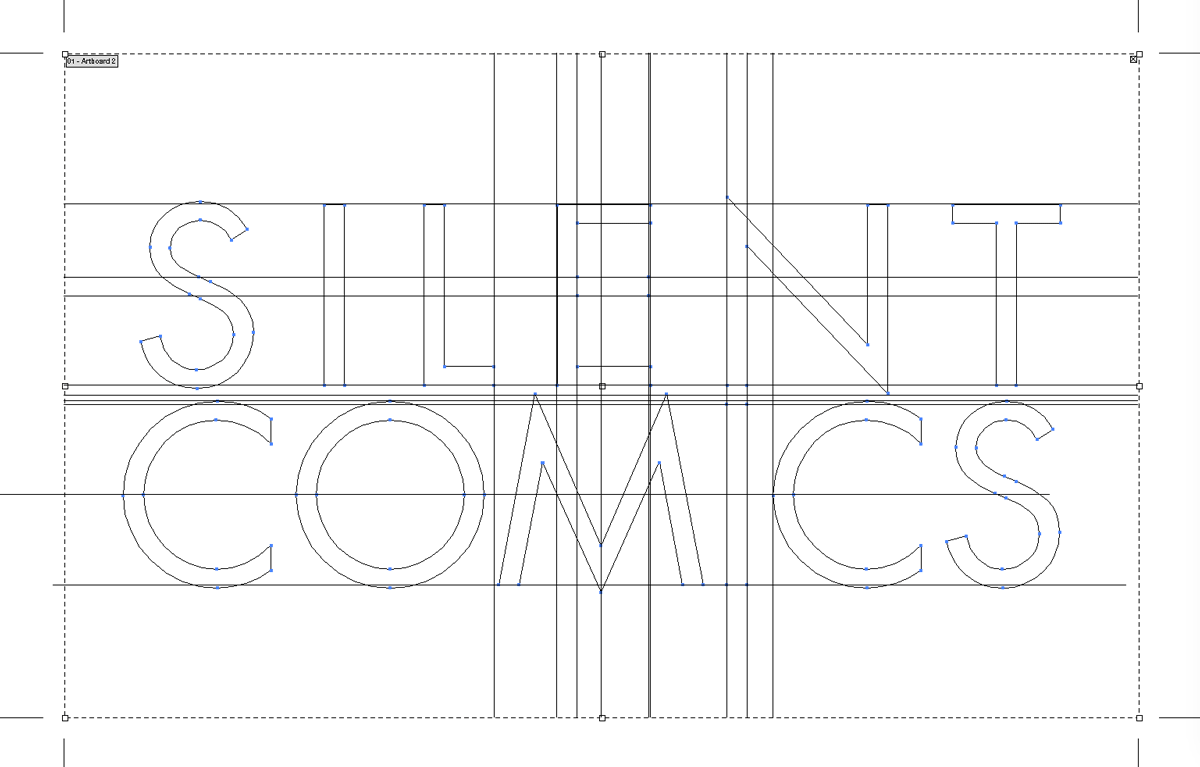
<img src="/images/SILENT-COMICS_script_outline.png" />
<figcaption>Logo outline.</figcaption>
</figure>

<h2 id="svg">SVG</h2>
<p>Base64<sup id="fnref:2" role="doc-noteref"><a href="#fn:2" class="footnote" rel="footnote">2</a></sup> code:</p>

<figure class="highlight"><pre><code class="language-ruby" data-lang="ruby"><span class="o">&lt;</span><span class="n">a</span> <span class="n">href</span><span class="o">=</span><span class="err">“</span><span class="n">https</span><span class="ss">:/</span><span class="o">/</span><span class="n">silent</span><span class="o">-</span><span class="n">comics</span><span class="p">.</span><span class="nf">com</span><span class="err">”</span> <span class="k">class</span><span class="o">=</span><span class="err">“</span><span class="n">logo</span><span class="err">”</span><span class="o">&gt;&lt;</span><span class="n">object</span> <span class="n">type</span><span class="o">=</span><span class="err">“</span><span class="n">image</span><span class="o">/</span><span class="n">svg</span><span class="o">+</span><span class="n">xml</span><span class="err">”</span> <span class="n">data</span><span class="o">=</span><span class="err">“</span><span class="n">data</span><span class="ss">:image</span><span class="o">/</span><span class="n">svg</span><span class="o">+</span><span class="n">xml</span><span class="p">;</span><span class="n">base64</span><span class="p">,</span><span class="no">PHN2ZyB4bWxucz0iaHR0cDovL3d3dy53My5vcmcvMjAwMC9zdmciIHZpZXdCb3g9IjAgMCAxOTggOTkiPjxzdHlsZT4uc3R5bGUwe2ZpbGw6ICMwMDA7fTpob3ZlciB7ZmlsbDogI2ZmY2MwMDt9OnZpc2l0ZWQge2ZpbGw6ICNmZmY7fTwvc3R5bGU</span><span class="o">+</span><span class="no">IDxwYXRoIGQ9Ik0xNS40IDQ0LjJjLTQuMSAwLTcuMS0zLjItNy42LTcuMWwtNC4xIDEuMmMxLjIgNS45IDUuOCA5LjkgMTEuOSA5LjljNi42IDAgMTItNS4xIDEyLTExLjggYzAtNi4xLTQuMi04LjYtOS4yLTEwLjdsLTIuNS0xLjFjLTIuNi0xLjItNi0yLjctNi02YzAtMy41IDIuOS01LjkgNi4zLTUuOWMzLjIgMCA1LjEgMS41IDYuNiA0LjFsMy40LTIuMmMtMi0zLjctNS42LTUuOS05LjktNS45IGMtNS43IDAtMTAuNyAzLjgtMTAuNyA5LjdjMCA1LjUgMy44IDcuNyA4LjMgOS44bDIuMyAxYzMuNSAxLjYgNyAzLjEgNyA3LjZDMjMuMyA0MS4xIDE5LjUgNDQuMiAxNS40IDQ0LjJ6Ii8</span><span class="o">+</span><span class="no">PHJlY3QgeD0iNDIuNSIgeT0iOS40IiB3aWR0aD0iNC4zIiBoZWlnaHQ9IjM4LjIiLz48cG9seWdvbiBwb2ludHM9IjYzLjYsOS40IDYzLjYsNDcuNSA3OC4zLDQ3LjUgNzguMyw0My42IDY3LjgsNDMuNiA2Ny44LDkuNCIvPjxwb2x5Z29uIHBvaW50cz0iMTExLjQsMTMuMyAxMTEuNCw5LjQgOTEuNiw5LjQgOTEuNiw0Ny41IDExMS40LDQ3LjUgMTExLjQsNDMuNiA5NS45LDQzLjYgOTUuOSwyOC42IDExMSwyOC42IDExMSwyNC43IDk1LjksMjQuNyA5NS45LDEzLjMiLz48cG9seWdvbiBwb2ludHM9IjE1Ny4zLDM4LjkgMTI3LjUsNy44IDEyNy41LDQ3LjUgMTMxLjgsNDcuNSAxMzEuOCwxOC4xIDE2MS41LDQ5LjIgMTYxLjUsOS40IDE1Ny4zLDkuNCIvPjxwb2x5Z29uIHBvaW50cz0iMTc1LjIsMTMuMyAxODQuNCwxMy4zIDE4NC40LDQ3LjUgMTg4LjcsNDcuNSAxODguNywxMy4zIDE5OCwxMy4zIDE5OCw5LjQgMTc1LjIsOS40Ii8</span><span class="o">+</span><span class="no">PHBhdGggZD0iTTE5LjkgOTAuM2M0IDAgOC4xLTEuNCAxMS40LTMuN3YtNS4zYy0zIDMtNy4yIDUuMS0xMS41IDUuMWMtOC41IDAtMTUuNS03LjQtMTUuNS0xNS44IGMwLTguNCA2LjktMTUuOCAxNS40LTE1LjhjNC40IDAgOC42IDEuOSAxMS42IDUuMXYtNS4zYy0zLjQtMi41LTcuMS0zLjctMTEuNC0zLjdDOSA1MC45IDAgNTkuOCAwIDcwLjhDMCA4MS42IDkuMSA5MC4zIDE5LjkgOTAuMyB6Ii8</span><span class="o">+</span><span class="no">PHBhdGggZD0iTTM2LjUgNzAuN2MwIDExIDkgMTkuNyAxOS45IDE5LjdjMTAuOSAwIDE5LjktOC43IDE5LjktMTkuN2MwLTEwLjktOS0xOS44LTE5LjktMTkuOCBDNDUuNSA1MC45IDM2LjUgNTkuNyAzNi41IDcwLjd6IE01Ni40IDU0LjhDNjUuMiA1NC44IDcyIDYyIDcyIDcwLjZjMCA4LjYtNyAxNS44LTE1LjYgMTUuOGMtOC43IDAtMTUuNi03LjItMTUuNi0xNS44IEM0MC44IDYyIDQ3LjcgNTQuOCA1Ni40IDU0Ljh6Ii8</span><span class="o">+</span><span class="no">PHBvbHlnb24gcG9pbnRzPSI3OS4zLDg5LjcgODMuNiw4OS43IDg4LjUsNjMuOSA4OC42LDYzLjkgMTAwLjksOTEuMiAxMTMuMiw2My45IDExMy4zLDYzLjkgMTE4LjIsODkuNyAxMjIuNSw4OS43IDExNC44LDQ5LjQgMTAwLjksODEuNCA4Nyw0OS40Ii8</span><span class="o">+</span><span class="no">PHJlY3QgeD0iMTI3LjUiIHk9IjUxLjUiIHdpZHRoPSI0LjMiIGhlaWdodD0iMzguMSIvPjxwYXRoIGQ9Ik0xNTYuOSA1NC44YzQuNCAwIDguNiAxLjkgMTEuNiA1LjF2LTUuM2MtMy40LTIuNS03LjEtMy43LTExLjQtMy43Yy0xMC45IDAtMTkuOSA5LTE5LjkgMTkuOSBjMCAxMC44IDkuMSAxOS42IDE5LjkgMTkuNmM0IDAgOC4xLTEuNCAxMS40LTMuN3YtNS4zYy0zIDMtNy4yIDUuMS0xMS41IDUuMWMtOC41IDAtMTUuNS03LjQtMTUuNS0xNS44IEMxNDEuNiA2Mi4yIDE0OC40IDU0LjggMTU2LjkgNTQuOHoiLz48cGF0aCBkPSJNMTg1LjcgODYuNGMtNC4xIDAtNy4xLTMuMi03LjYtNy4xbC00LjEgMS4yYzEuMiA1LjkgNS44IDkuOSAxMS45IDkuOWM2LjYgMCAxMi01LjEgMTItMTEuOCBjMC02LjEtNC4yLTguNi05LjItMTAuN2wtMi41LTEuMWMtMi42LTEuMi02LTIuNy02LTZjMC0zLjUgMi45LTUuOSA2LjMtNS45YzMuMiAwIDUuMSAxLjUgNi42IDQuMWwzLjQtMi4yYy0yLTMuNy01LjYtNS45LTkuOS01LjkgYy01LjcgMC0xMC43IDMuOC0xMC43IDkuN2MwIDUuNSAzLjggNy43IDguMyA5LjhsMi4zIDFjMy41IDEuNiA3IDMuMSA3IDcuNkMxOTMuNiA4My4zIDE4OS44IDg2LjQgMTg1LjcgODYuNHoiLz48cmVjdCB5PSI5NyIgd2lkdGg9IjE5OCIgaGVpZ2h0PSIyIi8</span><span class="o">+</span><span class="no">PHJlY3QgeT0iMCIgd2lkdGg9IjE5OCIgaGVpZ2h0PSIyIi8</span><span class="o">+</span><span class="no">PC9zdmc</span><span class="o">+</span><span class="err">”</span><span class="o">&gt;&lt;</span><span class="sr">/object&gt;&lt;/</span><span class="n">a</span><span class="o">&gt;</span></code></pre></figure>

<script src="https://gist.github.com/SilentComics/2898cb8706eff2eb2398cb263624a118.js"></script>

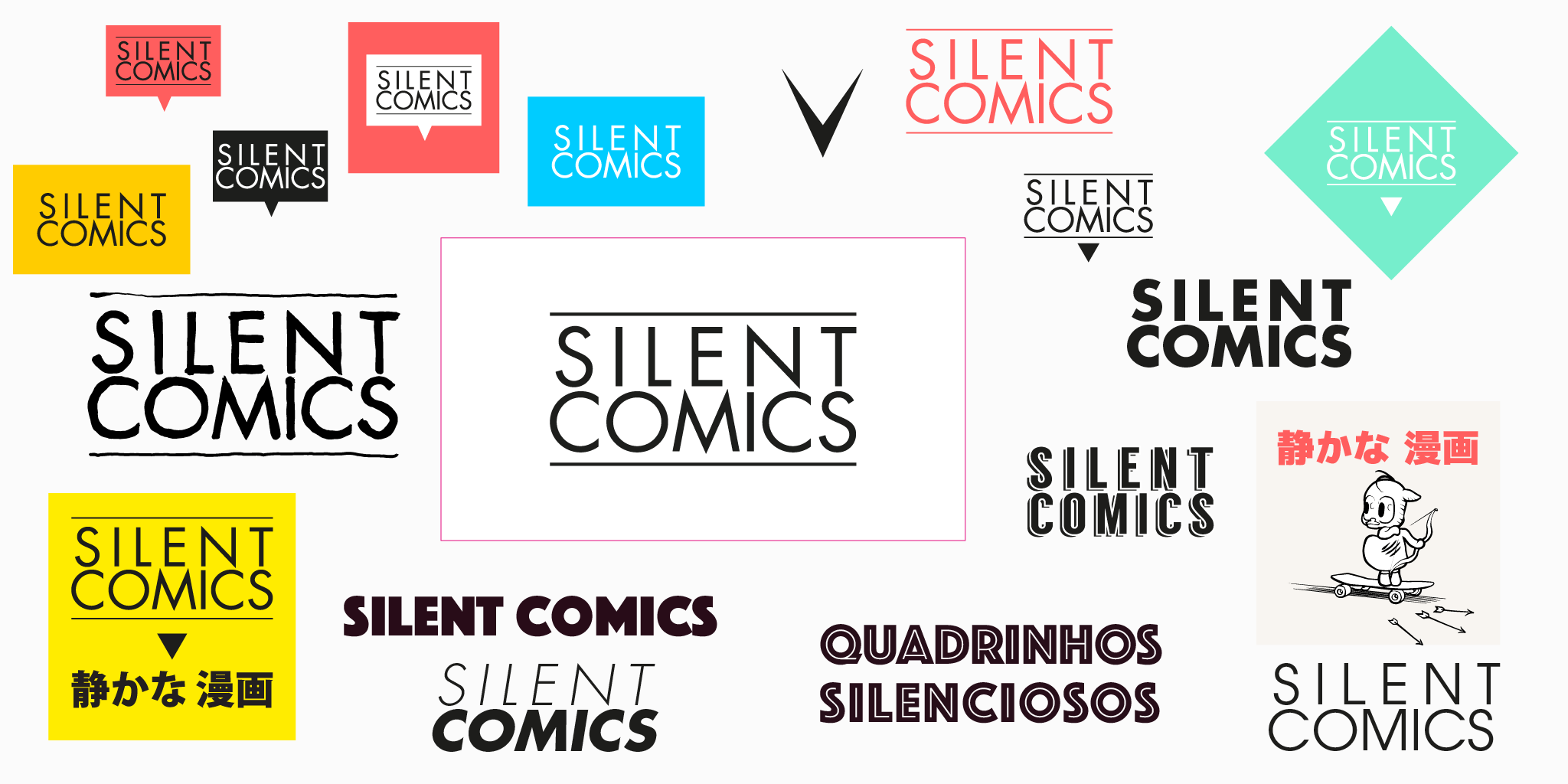
<figure>
<img src="/images/SILENT-COMICS-Script-Overview.png" />
<figcaption>Logo sketches</figcaption>
</figure>

<figure>
<img src="/images/Silent-Comic_script_handmade_01.png" />
<figcaption>Logo — hand-drawn version</figcaption>
</figure>

<h2 id="graphic--design-guidelines">Graphic  design guidelines</h2>
<p><em>(to be continued)</em></p>

<div class="footnotes" role="doc-endnotes">
  <ol>
    <li id="fn:1" role="doc-endnote">
      <p>“(…) il était admis, tout le monde l’admettait, que, une bande dessinée, c’était d’abord une histoire. Or, je n’ai jamais été d’accord: c’est pas d’abord une histoire, c’est d’abord une bande dessinée, c’est d’abord du dessin.” <a href="https://www.youtube.com/watch?v=Vs5RsyrcYKg">https://www.youtube.com/watch?v=Vs5RsyrcYKg</a>. See also Philippe Lefèvre-Vakana. “à la recherche d’un chef-d’œuvre de raymond poïvet” (2011, in French) <a href="http://neuviemeart.citebd.org/spip.php?article437">http://neuviemeart.citebd.org/spip.php?article437</a> <a href="#fnref:1" class="reversefootnote" role="doc-backlink">&#8617;</a></p>
    </li>
    <li id="fn:2" role="doc-endnote">
      <p>Thanks to <a href="http://www.mobilefish.com/services/base64/base64.php" title="Mobilefish’s Base64 Encoder">Mobilefish’s Base64 Encoder</a> to encode a SVG file. See also <a href="http://css-tricks.com/using-svg/" title="Using SVG - CSS Tricks">Using SVG - CSS Tricks</a> <a href="#fnref:2" class="reversefootnote" role="doc-backlink">&#8617;</a></p>
    </li>
  </ol>
</div>]]></content><author><name>SILENT COMICS</name><uri>https://silent-comics.com</uri></author><category term="[&quot;design&quot;, &quot;typography&quot;]" /><category term="SILENT COMICS" /><summary type="html"><![CDATA[The design process behind the SILENT COMICS wordmark.]]></summary></entry><entry><title type="html">Revisiting an old format: the wordless book.</title><link href="https://log.silentcomics.com/storytelling/revisiting-an-old-format/" rel="alternate" type="text/html" title="Revisiting an old format: the wordless book." /><published>2014-12-02T00:00:00+00:00</published><updated>2014-12-02T00:00:00+00:00</updated><id>https://log.silentcomics.com/storytelling/revisiting-an-old-format</id><content type="html" xml:base="https://log.silentcomics.com/storytelling/revisiting-an-old-format/"><![CDATA[<p>Wordless comics are rare. Yet, this visual language offers a wide range of possibilities to explore, for instance:</p>

<h2 id="contemplative-stories">Contemplative stories</h2>
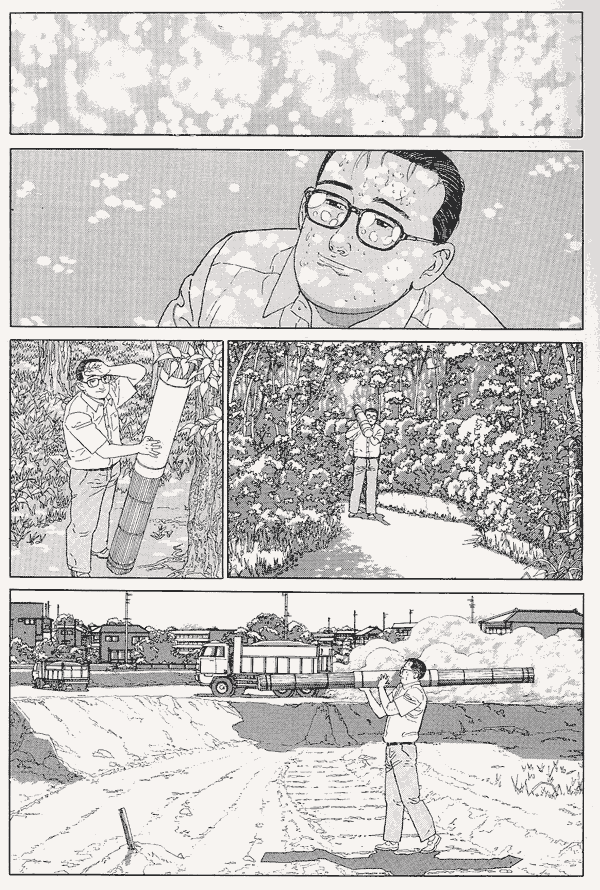
<p>Contemplative stories are visual by nature. <em>Aruku Hito</em> — 歩くひと, a manga that tells a long-form story with next to no words is a fine example. Translated into English as <em>The Walking Man</em> and in French as <em>L’Homme qui Marche</em>.</p>

<p><a href="/images/Taniguchi_walking_man_page.png"><img src="/images/Taniguchi_walking_man_page-600-607df6d28.png" alt="A page from The Walking Man — 歩くひと" srcset="/images/Taniguchi_walking_man_page-400-607df6d28.png 400w, /images/Taniguchi_walking_man_page-600-607df6d28.png 600w"></a></p>
<figcaption>A page from The Walking Man — 歩くひと</figcaption>

<h2 id="dreamlike-stories">Dreamlike stories</h2>
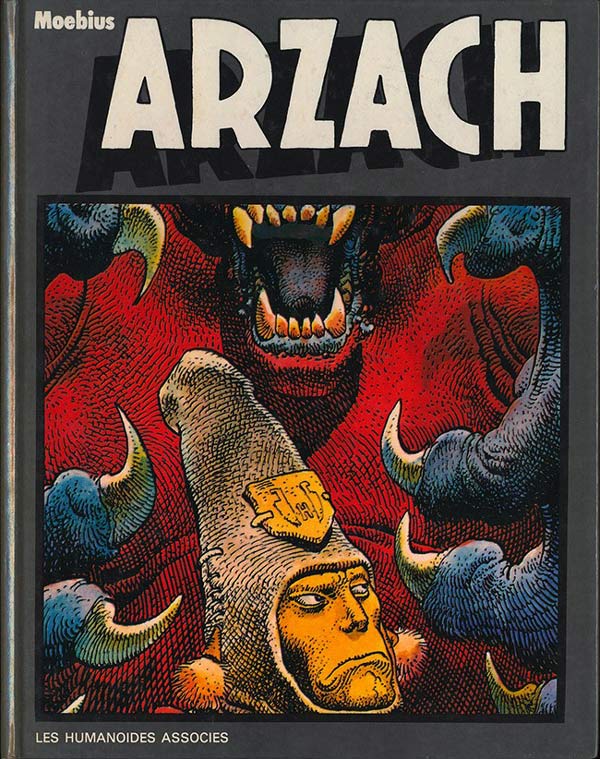
<p>Stories that explore the ”mindscape” of the subconscious. In this genre, impossible to leave out <em>Arzach</em><sup id="fnref:1" role="doc-noteref"><a href="#fn:1" class="footnote" rel="footnote">1</a></sup>, a magnificent silent comic, published in 1975. Its sheer force inspired and will continue to inspire generations of illustrators.</p>

<p><a href="/images/Arzach-02.jpg"><img src="/images/Arzach-02-600-ba9989b9f.jpg" alt="Arzach’s original cove by Moebius" srcset="/images/Arzach-02-400-ba9989b9f.jpg 400w, /images/Arzach-02-600-ba9989b9f.jpg 600w"></a></p>
<figcaption>Arzach’s original cover by Moebius</figcaption>

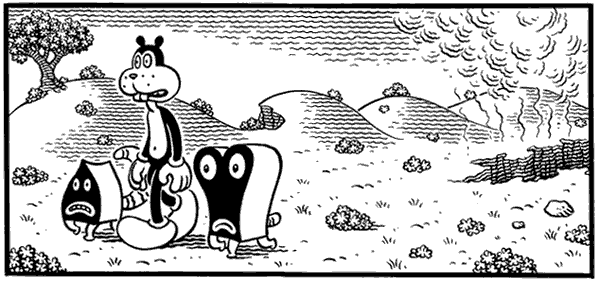
<p>Quasi-wordless, <a href="http://www.jimwoodring.com">Jim Woodring</a>’s <em>Frank</em> books are another extraordinary example. <em>Frank</em>’s adventures happen in a self-contained startling world, surreal, and at times eerie.</p>

<p><a href="/images/Congres-of-the-animals-panel.png"><img src="/images/Congres-of-the-animals-panel-600-25ecc0e0e.png" alt="Panel from Congress of the Animals, by Jim Woodring" srcset="/images/Congres-of-the-animals-panel-400-25ecc0e0e.png 400w, /images/Congres-of-the-animals-panel-600-25ecc0e0e.png 600w"></a></p>
<figcaption>Panel from Congress of the Animals, by  Jim Woodring</figcaption>

<h2 id="visual-poetry">Visual poetry</h2>
<p>I don’t know what visual poetry is, don’t ask me, but it exists. In this genre, sequences of images are at work, regardless of any meaningful storyline.</p>

<h2 id="children-books">Children books</h2>
<p>Wordless books have a rich tradition that predates comics. In recent years, (long-form) wordless comics aimed at youths began to resurface. Though not limited to preschool years, these books are a logical step for kids who have yet to learn reading.</p>

<h2 id="alternative-comics">Alternative comics</h2>
<p>Wordless stories addressing adult themes such as <em>Gegika</em>, or “dramatic picture books”, as coined by the late <a href="http://www.nytimes.com/2015/03/13/arts/yoshihiro-tatsumi-japanese-cartoonist-of-dark-stories-is-dead-at-79.html?_r=0">Yoshihiro Tatsumi</a>. Graphic novels, <em>Nouvelle Manga</em>, and <em>Fusion Comics</em>. All these genres push visual narration forward.</p>

<h2 id="action">Action</h2>
<p>Fast-paced sequences rendered in extreme slow-motion are perfect for wordless comics. With a lot of “cuts” for a single scene, they look close to a detailed film storyboard. This cinematic stylistic technique is sometimes referred to as <a href="http://bit.ly/decompression-comics"><em>decompression</em></a> in comics.</p>

<h2 id="explanatory-and-didactic">Explanatory and didactic</h2>
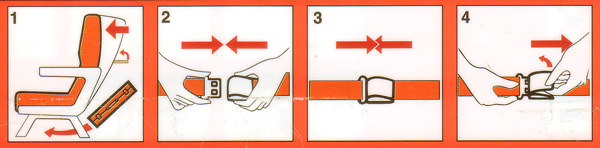
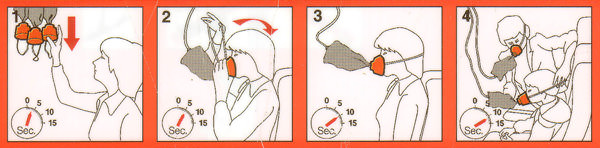
<p>Comics that work as info-graphics. Companies sometimes use these in their communication charts and how-to guides. Technical manuals, infographics, plane emergency leaflets, and warning signs are typical examples. But it could also work for a martial art manual, any book involving learning movement, like dance or gymnastics, and synchronization skills, like in choreography.</p>

<figure>
	<img src="/images/air-berlin-airbus-a319-belt.jpg" />
	<figcaption></figcaption>
</figure>

<figure>
	<img src="/images/air-berlin-airbus-a319-mask.jpg" />
	<figcaption>Plane emergency leaflet</figcaption>
</figure>

<h2 id="scientific-vulgarisation">Scientific vulgarisation</h2>

<p>Comics can help to present complex subjects with a deeper cognitive dimension.
The borders between literacy and visual literacy<sup id="fnref:2" role="doc-noteref"><a href="#fn:2" class="footnote" rel="footnote">2</a></sup> blur. Both can be essential to learning.</p>

<h2 id="propaganda-and-pamphlets">Propaganda and Pamphlets</h2>
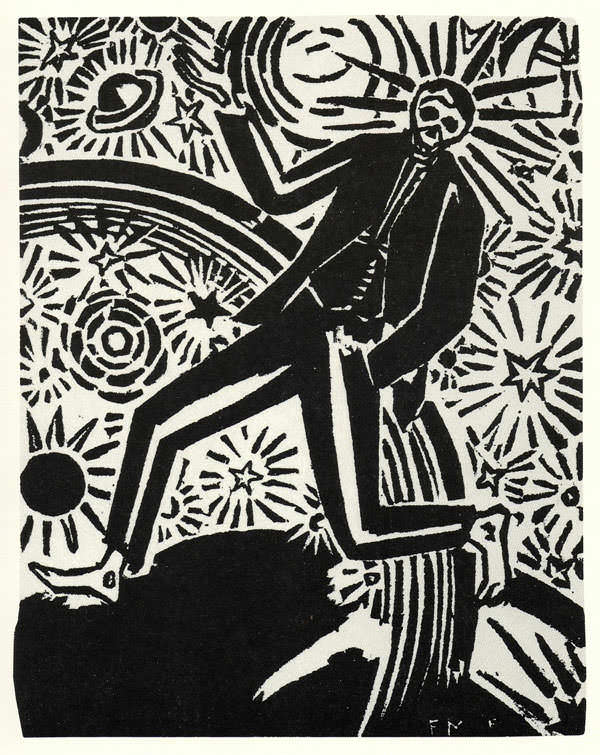
<p>With their straightforward visual nature, wordless comics are well suited for propaganda and pamphlets. The first wordless novels appeared in close association with protest movements during the 20’ and 30’. Their topics were war, social injustice, and rebellion. Artists like Frans Masereel were eager to address social commentary and controversial themes. At their time of publication, wordless novels were popular, reaching a large audience<sup id="fnref:3" role="doc-noteref"><a href="#fn:3" class="footnote" rel="footnote">3</a></sup>. Woodcut’s economy of lines, coupled with the absence of text made wordless novels an ideal medium to reach the masses.</p>

<figure>
	<img src="/images/Frans_Masereel_1919_Mon_livre_d_heures_final_panel.jpg" />
	<figcaption>Final Panel from Frans Masereel’s Passionate Journey</figcaption>
</figure>

<h2 id="advertising">Advertising</h2>
<p>As we see, visuals can have way more impact than words. Advertisers love to use the same graphic language than activists, to other ends. In fact, they often each repurpose one another’s codes. There are countless examples of advertising using visual only, as well as of comics used in advertising. Yet I have never seen a wordless comic in an advertisement. Advertising tries to make the most of a medium, and it is rare to see a print ad without a copy or a poster without a tagline. If you reduce a corporate message to its essence, you reach a point where there is only a brand mark left. Thus the best way to use wordless comics for an ad would be creating a sequential story based on a logo.</p>

<h2 id="with-so-much-potential-why-are-there-so-few">With so much potential, why are there so few?</h2>
<p>First, rarity is relative. There are many wordless comics in circulation already. And new artists keep rejuvenating the form. Yet only a small percentage of the total comics published each year don’t use words. Somehow wordless comics are still less expected. For most people, the combination of words and pictures is what makes comics. Definitions aside, readers expect picture <em>and</em> words. We are still in a culture where verbal communication takes the primacy over image<sup id="fnref:4" role="doc-noteref"><a href="#fn:4" class="footnote" rel="footnote">4</a></sup>. Even if images are omnipresent and perhaps more direct. In this context, wordless comics might seem arcane, less attractive to readers. But are they also less efficient at telling stories?</p>

<p>If the answer is yes, it leads to another explanation. It is hard to find good ones because it is hard to create them in the first place. The literacy rate is high enough that the demand for such stories is no longer mainstream—if it ever was. We can look for correspondence with silent films and wordless novels. But the landscape has changed. There are no longer just books, no more cinema. Those times are gone. Now <em>everything</em> is supposed to be entertainment. Creating a good wordless comic today means competing with sophisticated mediums. Digital comics, print, film, video games, TV, web and computer animation, even virtual reality.</p>

<h2 id="narrative-challenges">Narrative challenges</h2>
<p>From a narrative perspective, rarity highlights how difficult it is to make wordless stories <em>work</em>. For all its apparent simplicity, it is a form that calls for sustained attention. At a time of information overload, compulsive reading, zapping and multimedia disruption, attention is the scarcest resource<sup id="fnref:5" role="doc-noteref"><a href="#fn:5" class="footnote" rel="footnote">5</a></sup>. This is especially true for long-form. Short form comics, with a   few panels in a single strip, are widespread and thrive on the web. Indeed, strips or cartoon are an ideal format for the web’s quick consumption mode. They excel at grabbing the shortening attention span of online readers<sup id="fnref:6" role="doc-noteref"><a href="#fn:6" class="footnote" rel="footnote">6</a></sup>. Whereas long-form visual narrative cannot depend on text to save a poor picture. Images must keep the viewer interested without the help of text. Intricate or minimal, pictures alone must steer the reader’s curiosity. Frame by frame for an entire story.</p>

<h2 id="things-pictures-cannot-say">Things pictures cannot say.</h2>

<blockquote>
  <p>A picture is worth a thousand words</p>
</blockquote>

<blockquote>
  <p>One showing is worth a hundred sayings</p>
</blockquote>

<p><a href="http://www2.cs.uregina.ca/~hepting/research/web/words/history.html">The history of a picture’s worth</a>, shows the rise of a fake proverb, coming from advertising. However, that idea was present in literature for a longer time:</p>

<blockquote>
  <p>A picture shows me at a glance what it takes dozens of pages of a book to expound.
—IVAN TURGENEV</p>
</blockquote>

<p>All these, in essence, summarise “show, don’t tell”.</p>

<p>There are counter sayings:</p>

<blockquote>
  <p>As the Chinese say, 1001 words is worth more than a picture.
—JOHN  McCARTHY</p>
</blockquote>

<blockquote>
  <p><a href="https://www.youtube.com/watch?v=ej_aFOnT04g">Pictures are worth like a thousand words max. An alphabet can make up a bazillion words.</a>
—DAN HARMON</p>
</blockquote>

<p>For all the sayings, there is a surprising amount of things you cannot tell with pictures alone. Words can convey better or with less effort than imagery a lot of subtle, intangible things. For instance, dialogues, summaries, time and place indications. Captions driving the story forward. To create a wordless story you have to replace a lot of written information by pictures. Silent films found a partial solution to this limitation with the title card. But silent films have at least two things that wordless comics lack: movement and soundtrack<sup id="fnref:7" role="doc-noteref"><a href="#fn:7" class="footnote" rel="footnote">7</a></sup>. Both are expression and emotion amplifiers. Compared to Cinema, comics is a simpler medium. Wordless comics are even more minimal. But here too, the comparison falls short: there are stories one can never tell with a certain medium, and stories best for a particular form.</p>

<blockquote>
  <p>I always feel that to adapt a comic-book story into a live-action picture is a mistake. The two look similar only on the surface, but at heart, they are truly different. (…) Cinema <em>is</em> movement. Comics are immobility. Comics create movement from immobility. The genius of comics is that they force the reader to create movement. —ALEXANDRO JODOROWSKY</p>
</blockquote>

<p>Wordless comics call for a different form of reading. The reader is no longer required to read but derives a story interpretation from watching static images series. Can narrative limitation rejuvenate the form? The musicality of words, onomatopoeia, and annotations are lost but only to offer a different experience.</p>

<h2 id="visual-literacy">Visual literacy</h2>
<p>One of the main advantages of telling a story through visuals-only is universality. Imagine a story anyone can understand anywhere, without any language barrier. Yet different cultural codes are at play in American, European and Japanese comics. Visual languages differ between cultures. Neil Cohn<sup id="fnref:8" role="doc-noteref"><a href="#fn:8" class="footnote" rel="footnote">8</a></sup> studies show striking disparities in visual literacy<sup id="fnref:9" role="doc-noteref"><a href="#fn:9" class="footnote" rel="footnote">9</a></sup> across cultures. Today we live in a visual era, yet words still prevail over images, and visual literacy tends to be overlooked. The case for using words to communicate is strong even if they leave a lot to interpretation. Words are everyday language, with which we communicate despite their limitation. Whereas films and comics stories come with defined imagery that leaves less to the imagination of their audience than would a book of fiction. Even predominantly visual works such as films and comics often originate in words (a scenario, script or screenplay).</p>

<h2 id="the-future-of-wordless-comics">The Future of wordless comics</h2>

<p><em>Visual narrative / visual storytelling</em></p>

<p>For this simple, next to a primitive art form to be successful, it must tell a good story. A story nobody has ever seen before, or an old one, told from a new perspective. Compelling imagery is not enough. Imagine sitting and watching a slideshow of beautiful images. How boring. Building a mercurial story to take the reader (watcher) by surprise requires more. Optimal clarity is imperative to capture and keep the viewer’s interest. What do your pictures mean? Your audience shouldn’t have to do any guesswork to find out. You can still use hermetic visual clues but only if it serves a purpose within the story.</p>

<p>Wordless comics offer a simple, different form of reading. Time and pace are still paramount to narrative success and satisfactory reading. As a wordless comics reader, you must still be in control of your reading pace to engage and immerse in the story. But reading pictures call for a different kind of effort on your part. In the absence of text, you might have to linger over the pictures a little more to understand what’s going on.</p>

<p>Pure visual storytelling in long-form without complex paneling or fancy comics tricks is quite a challenge. It is about taking the most minimal resource to maximal effect. Telling a story with a succession of images in a single panel ratio from beginning to end. Just as a writer creates a whole world in the mind of the reader, with nothing else but words.</p>

<p>Despite or thanks to their limitations, there is more to wordless comics than meet the eye. <em>Watch this space.</em></p>

<hr />

<h2 id="further-reads">Further reads:</h2>

<p><a href="https://www.amazon.com/gp/product/8493340995/ref=as_li_ss_il?ie=UTF8&amp;linkCode=li3&amp;tag=shizukana-20&amp;linkId=156b7a7dce62c3c00baff077c8973a72&amp;language=en_US" target="_blank"><img border="0" src="//ws-na.amazon-adsystem.com/widgets/q?_encoding=UTF8&amp;ASIN=8493340995&amp;Format=_SL250_&amp;ID=AsinImage&amp;MarketPlace=US&amp;ServiceVersion=20070822&amp;WS=1&amp;tag=shizukana-20&amp;language=en_US" /></a><img src="https://ir-na.amazon-adsystem.com/e/ir?t=shizukana-20&amp;language=en_US&amp;l=li3&amp;o=1&amp;a=8493340995" width="1" height="1" border="0" alt="" style="border:none !important; margin:0px !important;" /></p>

<h5 id="the-walking-man-by-jiro-taniguchi"><a href="https://www.amazon.com/gp/product/8493340995/ref=as_li_tl?ie=UTF8&amp;camp=1789&amp;creative=390957&amp;creativeASIN=8493340995&amp;linkCode=as2&amp;tag=shizukana-20&amp;linkId=JQL5IDM6U4H76FIU"><em>The Walking Man</em></a> by Jiro Taniguchi</h5>

<p><br />
<a href="https://www.amazon.com/gp/product/1569711321/ref=as_li_ss_il?ie=UTF8&amp;linkCode=li3&amp;tag=shizukana-20&amp;linkId=30f142d6b17fff2e2188e8f9b8c9ca42&amp;language=en_US" target="_blank"><img border="0" src="//ws-na.amazon-adsystem.com/widgets/q?_encoding=UTF8&amp;ASIN=1569711321&amp;Format=_SL250_&amp;ID=AsinImage&amp;MarketPlace=US&amp;ServiceVersion=20070822&amp;WS=1&amp;tag=shizukana-20&amp;language=en_US" /></a><img src="https://ir-na.amazon-adsystem.com/e/ir?t=shizukana-20&amp;language=en_US&amp;l=li3&amp;o=1&amp;a=1569711321" width="1" height="1" border="0" alt="" style="border:none !important; margin:0px !important;" /></p>

<h5 id="arzach-by-moebius--the-first-edition-les-humanoides-associés-of-this-masterpiece-is-unfortunately-out-of-print"><a href="https://www.amazon.com/gp/product/1569711321/ref=as_li_tl?ie=UTF8&amp;camp=1789&amp;creative=390957&amp;creativeASIN=1569711321&amp;linkCode=as2&amp;tag=shizukana-20&amp;linkId=A6OELNLRFD2OYCOZ"><em>Arzach</em></a> by Moebius — The first edition (Les Humanoides Associés) of this masterpiece is unfortunately out of print.</h5>

<p><br />
<a href="https://www.amazon.com/gp/product/1560975342/ref=as_li_ss_il?ie=UTF8&amp;linkCode=li3&amp;tag=shizukana-20&amp;linkId=2410ecb980a28bf880328372f03deae5&amp;language=en_US" target="_blank"><img border="0" src="//ws-na.amazon-adsystem.com/widgets/q?_encoding=UTF8&amp;ASIN=1560975342&amp;Format=_SL250_&amp;ID=AsinImage&amp;MarketPlace=US&amp;ServiceVersion=20070822&amp;WS=1&amp;tag=shizukana-20&amp;language=en_US" /></a><img src="https://ir-na.amazon-adsystem.com/e/ir?t=shizukana-20&amp;language=en_US&amp;l=li3&amp;o=1&amp;a=1560975342" width="1" height="1" border="0" alt="" style="border:none !important; margin:0px !important;" /></p>

<h5 id="the-frank-book-by-jim-woodring"><a href="https://www.amazon.com/gp/product/1560975342/ref=as_li_tl?ie=UTF8&amp;camp=1789&amp;creative=390957&amp;creativeASIN=1560975342&amp;linkCode=as2&amp;tag=shizukana-20&amp;linkId=3U5EIJ2IO6NF64XW"><em>The Frank Book</em></a> by Jim Woodring</h5>

<p><br />
<a href="https://www.amazon.com/gp/product/1935429396/ref=as_li_ss_il?ie=UTF8&amp;linkCode=li3&amp;tag=shizukana-20&amp;linkId=a6e4248f851923093906a07478cf5f08&amp;language=en_US" target="_blank"><img border="0" src="//ws-na.amazon-adsystem.com/widgets/q?_encoding=UTF8&amp;ASIN=1935429396&amp;Format=_SL250_&amp;ID=AsinImage&amp;MarketPlace=US&amp;ServiceVersion=20070822&amp;WS=1&amp;tag=shizukana-20&amp;language=en_US" /></a><img src="https://ir-na.amazon-adsystem.com/e/ir?t=shizukana-20&amp;language=en_US&amp;l=li3&amp;o=1&amp;a=1935429396" width="1" height="1" border="0" alt="" style="border:none !important; margin:0px !important;" /></p>

<h5 id="gon-ゴン-漫画-by-masashi-tanaka"><a href="https://www.amazon.com/gp/product/1935429396/ref=as_li_tl?ie=UTF8&amp;camp=1789&amp;creative=390957&amp;creativeASIN=1935429396&amp;linkCode=as2&amp;tag=shizukana-20&amp;linkId=SXHR3EHJGV7CN5FO"><em>Gon</em></a> ゴン (漫画) by Masashi Tanaka</h5>

<p><br />
<a href="https://www.amazon.com/gp/product/1554072700/ref=as_li_ss_il?ie=UTF8&amp;linkCode=li3&amp;tag=shizukana-20&amp;linkId=d2116019f61106cbdcf6f2c1a15b2a41&amp;language=en_US" target="_blank"><img border="0" src="//ws-na.amazon-adsystem.com/widgets/q?_encoding=UTF8&amp;ASIN=1554072700&amp;Format=_SL250_&amp;ID=AsinImage&amp;MarketPlace=US&amp;ServiceVersion=20070822&amp;WS=1&amp;tag=shizukana-20&amp;language=en_US" /></a><img src="https://ir-na.amazon-adsystem.com/e/ir?t=shizukana-20&amp;language=en_US&amp;l=li3&amp;o=1&amp;a=1554072700" width="1" height="1" border="0" alt="" style="border:none !important; margin:0px !important;" /></p>

<h5 id="graphic-witness-four-wordless-graphic-novels-by-frans-masereel-lynd-ward-giacomo-patri-and-laurence-hyde"><a href="https://www.amazon.com/gp/product/1554072700/ref=as_li_tl?ie=UTF8&amp;camp=1789&amp;creative=390957&amp;creativeASIN=1554072700&amp;linkCode=as2&amp;tag=shizukana-20&amp;linkId=TJMOHS2JB5G4E47A"><em>Graphic Witness: Four Wordless Graphic Novels</em></a> by Frans Masereel, Lynd Ward, Giacomo Patri and Laurence Hyde</h5>

<p><br />
<a href="https://www.amazon.com/gp/product/1441181458/ref=as_li_ss_il?ie=UTF8&amp;linkCode=li3&amp;tag=shizukana-20&amp;linkId=ee6cf8f6cda59a2d0cb3e5adeb78146a&amp;language=en_US" target="_blank"><img border="0" src="//ws-na.amazon-adsystem.com/widgets/q?_encoding=UTF8&amp;ASIN=1441181458&amp;Format=_SL250_&amp;ID=AsinImage&amp;MarketPlace=US&amp;ServiceVersion=20070822&amp;WS=1&amp;tag=shizukana-20&amp;language=en_US" /></a><img src="https://ir-na.amazon-adsystem.com/e/ir?t=shizukana-20&amp;language=en_US&amp;l=li3&amp;o=1&amp;a=1441181458" width="1" height="1" border="0" alt="" style="border:none !important; margin:0px !important;" /></p>

<h5 id="the-visual-language-of-comics-introduction-to-the-structure-and-cognition-of-sequential-images-continuum-advances-in-semiotics-by-neil-cohn"><a href="https://www.amazon.com/gp/product/1441181458/ref=as_li_tl?ie=UTF8&amp;camp=1789&amp;creative=390957&amp;creativeASIN=1441181458&amp;linkCode=as2&amp;tag=shizukana-20&amp;linkId=N5UN3ML4AC2GS6YM"><em>The Visual Language of Comics: Introduction to the Structure and Cognition of Sequential Images. (Continuum Advances in Semiotics)</em></a> by Neil Cohn</h5>

<p><br />
<a href="https://www.amazon.com/Language-Comics-Word-Image/dp/1578064147//ref=as_li_ss_il?ie=UTF8&amp;linkCode=li3&amp;tag=shizukana-20&amp;linkId=9c6b7578986ffad8a9e4a2496d67e834&amp;language=en_US" target="_blank"><img border="0" src="//ws-na.amazon-adsystem.com/widgets/q?_encoding=UTF8&amp;ASIN=1578064147&amp;Format=_SL250_&amp;ID=AsinImage&amp;MarketPlace=US&amp;ServiceVersion=20070822&amp;WS=1&amp;tag=shizukana-20&amp;language=en_US" /></a><img src="https://ir-na.amazon-adsystem.com/e/ir?t=shizukana-20&amp;language=en_US&amp;l=li3&amp;o=1&amp;a=1578064147" width="1" height="1" border="0" alt="" style="border:none !important; margin:0px !important;" /></p>

<h5 id="the-language-of-comics-word-and-image-by-by-robin-varnum-editor-christina-t-gibbons-editor"><a href="https://www.amazon.com/Language-Comics-Word-Image/dp/1578064147//ref=as_li_ss_tl?ie=UTF8&amp;linkCode=ll1&amp;tag=shizukana-20&amp;linkId=f4e6aada2027853d97c2a35083c390b5"><em>The Language of Comics: Word and Image</em></a> by by Robin Varnum (Editor),‎ Christina T. Gibbons (Editor)</h5>

<h4 id="footnotes">Footnotes:</h4>

<h6 id="philippe-lefèvre-vakana-à-la-recherche-dun-chef-dœuvre-de-raymond-poïvet-in-french-2003-revised-2011-accessed-december-28-2014-httpneuviemeartcitebdorgspipphparticle437">Philippe Lefèvre-Vakana. “à la recherche d’un chef-d’œuvre de Raymond Poïvet” (in French, 2003, revised, 2011) Accessed December 28, 2014. <a href="http://neuviemeart.citebd.org/spip.php?article437">http://neuviemeart.citebd.org/spip.php?article437</a></h6>

<h6 id="jessie-bi-la-bande-dessinée-muette-d9-in-french-june-2006-accessed-april-2-2014-httpwwwdu9orgdossierbande-dessinee-muette-1-la">Jessie Bi. “La bande dessinée muette” D9 (in French, June 2006) Accessed April 2, 2014. <a href="http://www.du9.org/dossier/bande-dessinee-muette-1-la/">http://www.du9.org/dossier/bande-dessinee-muette-1-la/</a></h6>

<h6 id="imagetext--interdisciplinary-comics-studies-httpwwwenglishufleduimagetext">ImageTexT — Interdisciplinary Comics Studies <a href="http://www.english.ufl.edu/imagetext/">http://www.english.ufl.edu/imagetext/</a></h6>

<h6 id="david-robson-are-we-hard-wired-to-doodle-october-2014-accessed-october-1-2014-httpwwwbbccomfuturestory20140930-are-we-hardwired-to-doodle">David Robson. “Are we hard-wired to doodle?” (October 2014) Accessed October 1, 2014 <a href="http://www.bbc.com/future/story/20140930-are-we-hardwired-to-doodle">http://www.bbc.com/future/story/20140930-are-we-hardwired-to-doodle</a></h6>

<h6 id="steven-brower-the-advertising-power-of-comic-book-artists-april-25-2012-accessed-may-23-2015-httpwwwprintmagcomillustrationthe-advertising-power-of-comic-book-artists">Steven Brower. “The Advertising Power of Comic Book Artists” (April 25, 2012) Accessed May 23, 2015 <a href="http://www.printmag.com/illustration/the-advertising-power-of-comic-book-artists/">http://www.printmag.com/illustration/the-advertising-power-of-comic-book-artists/</a></h6>
<div class="footnotes" role="doc-endnotes">
  <ol>
    <li id="fn:1" role="doc-endnote">
      <p>Moebius said of <em>Arzach</em>, that he wanted “to bridge two insulated (airtight) worlds. That, humble, realist, of comic books, and that, immense and creative, of Art”. Raymond Poïvet’s wordless graphic novel <em>M.I.X. 315</em> plays with the same concept. Watch <a href="http://neuviemeart.citebd.org/spip.php?article452"><em>M.I.X. 315</em></a>, reproduced  online with permission by <strong>neuvièmeart 2.0</strong>. It looks like these pages played an inspirational role in the creation of Arzach. <a href="#fnref:1" class="reversefootnote" role="doc-backlink">&#8617;</a></p>
    </li>
    <li id="fn:2" role="doc-endnote">

      <p><a href="#fnref:2" class="reversefootnote" role="doc-backlink">&#8617;</a></p>
    </li>
    <li id="fn:3" role="doc-endnote">
      <p>For example, the German edition of Masereel’s <em>Passionate Journey</em>, <em>Mein Stundenbuch: 165 Holzschnitte</em> surpassed 100 000 copies in sales in Germany through several reprints. <a href="#fnref:3" class="reversefootnote" role="doc-backlink">&#8617;</a></p>
    </li>
    <li id="fn:4" role="doc-endnote">
      <p>This is changing. Cinema, television, and later the worldwide web created a cultural shift toward the visual over the verbal and textual, in the last century. Even the printed press, to some extend, became more reliant on images. The advent of the mobile web accelerated this tendency.  Visual (video + images) usage continues to rise. This is likely to continue with the coming age of immersive gaming, augmented reality and virtual reality. <a href="#fnref:4" class="reversefootnote" role="doc-backlink">&#8617;</a></p>
    </li>
    <li id="fn:5" role="doc-endnote">
      <p>“A visitor’s default behaviour isn’t to read every word, it’s to leave” — <a href="http://time.com/author/tony-haile/">Tony Haile</a>. <a href="#fnref:5" class="reversefootnote" role="doc-backlink">&#8617;</a></p>
    </li>
    <li id="fn:6" role="doc-endnote">
      <p>Tom Chatfield, Aeon, “The attention economy” Accessed May 31, 2016. <a href="https://aeon.co/essays/does-each-click-of-attention-cost-a-bit-of-ourselves">https://aeon.co/essays/does-each-click-of-attention-cost-a-bit-of-ourselves</a> <a href="#fnref:6" class="reversefootnote" role="doc-backlink">&#8617;</a></p>
    </li>
    <li id="fn:7" role="doc-endnote">
      <p>Digital comics have seen the emergence of accompanying sound or music, with mixed results. <a href="#fnref:7" class="reversefootnote" role="doc-backlink">&#8617;</a></p>
    </li>
    <li id="fn:8" role="doc-endnote">
      <p>Neil Cohn. “Downloadable papers on visual language research” <a href="http://www.visuallanguagelab.com/papers.html">http://www.visuallanguagelab.com/papers.html</a>. <a href="#fnref:8" class="reversefootnote" role="doc-backlink">&#8617;</a></p>
    </li>
    <li id="fn:9" role="doc-endnote">
      <p>“Framing ‘I can’t draw’: The influence of cultural frames on the development of drawing” <a href="http://www.visuallanguagelab.com/P/NC_drawingframes.pdf">http://www.visuallanguagelab.com/P/NC_drawingframes.pdf</a>. <a href="#fnref:9" class="reversefootnote" role="doc-backlink">&#8617;</a></p>
    </li>
  </ol>
</div>]]></content><author><name>SILENT COMICS</name><uri>https://silent-comics.com</uri></author><category term="[&quot;storytelling&quot;]" /><category term="comics" /><category term="wordless" /><summary type="html"><![CDATA[Storytelling: Revisiting an old format, the wordless book.]]></summary><media:thumbnail xmlns:media="http://search.yahoo.com/mrss/" url="https://log.silentcomics.com/%7B%22feature%22=%3Enil%7D" /><media:content medium="image" url="https://log.silentcomics.com/%7B%22feature%22=%3Enil%7D" xmlns:media="http://search.yahoo.com/mrss/" /></entry><entry><title type="html">The Draughtsman’s Sketchbook Creed</title><link href="https://log.silentcomics.com/drawing/The-Draughtsman-Sketchbook-Creed/" rel="alternate" type="text/html" title="The Draughtsman’s Sketchbook Creed" /><published>2014-09-11T00:00:00+00:00</published><updated>2014-09-11T00:00:00+00:00</updated><id>https://log.silentcomics.com/drawing/The-Draughtsman-Sketchbook-Creed</id><content type="html" xml:base="https://log.silentcomics.com/drawing/The-Draughtsman-Sketchbook-Creed/"><![CDATA[<p><em>My Sketchbook</em></p>

<p>This is my sketchbook. There are many like it, but this one is mine.</p>

<p>My sketchbook is my best friend. It is my life. I must master it as I must master my life.</p>

<p>My sketchbook, without me, is useless. Without my sketchbook, I am useless. I must sharpen my pencils true. I must draw faster than yesterday, before tomorrow kills me. I must draw everything before it draws me. I WILL…</p>

<p>My sketchbook and myself know that what counts in this life is not the rounds we trace, the noise of our nib, nor the dots we make. We know that it is the drawings that count. WE WILL DRAW…</p>

<p>My sketchbook is human, even as I, because it is my life. Thus, I will learn it as a brother. I will learn its weaknesses, its strength, its parts, its leaves, its spine and its back cover. I will ever guard it against the ravages of weather and damage as I will ever guard my legs, my arms, my eyes and my heart against damage. I will keep my sketchbook clean and ready. We will become part of each other. WE WILL…</p>

<p>Before my drawing peers, I swear this creed. My sketchbook and myself are the defenders of my integrity. We are the masters of our craft. WE ARE THE SAVIORS OF MY LIFE.</p>

<p>So be it, until victory is mine and there is no white page, but pictures!</p>

<h6 id="freely-adapted-from-the-united-states-marine-corps-riflemans-creed"><em>Freely adapted from the United States <a href="https://en.wikipedia.org/wiki/Rifleman%27s_Creed" title="US Marines - Marine Rifle Creed">Marine Corps Rifleman’s Creed</a>.</em></h6>

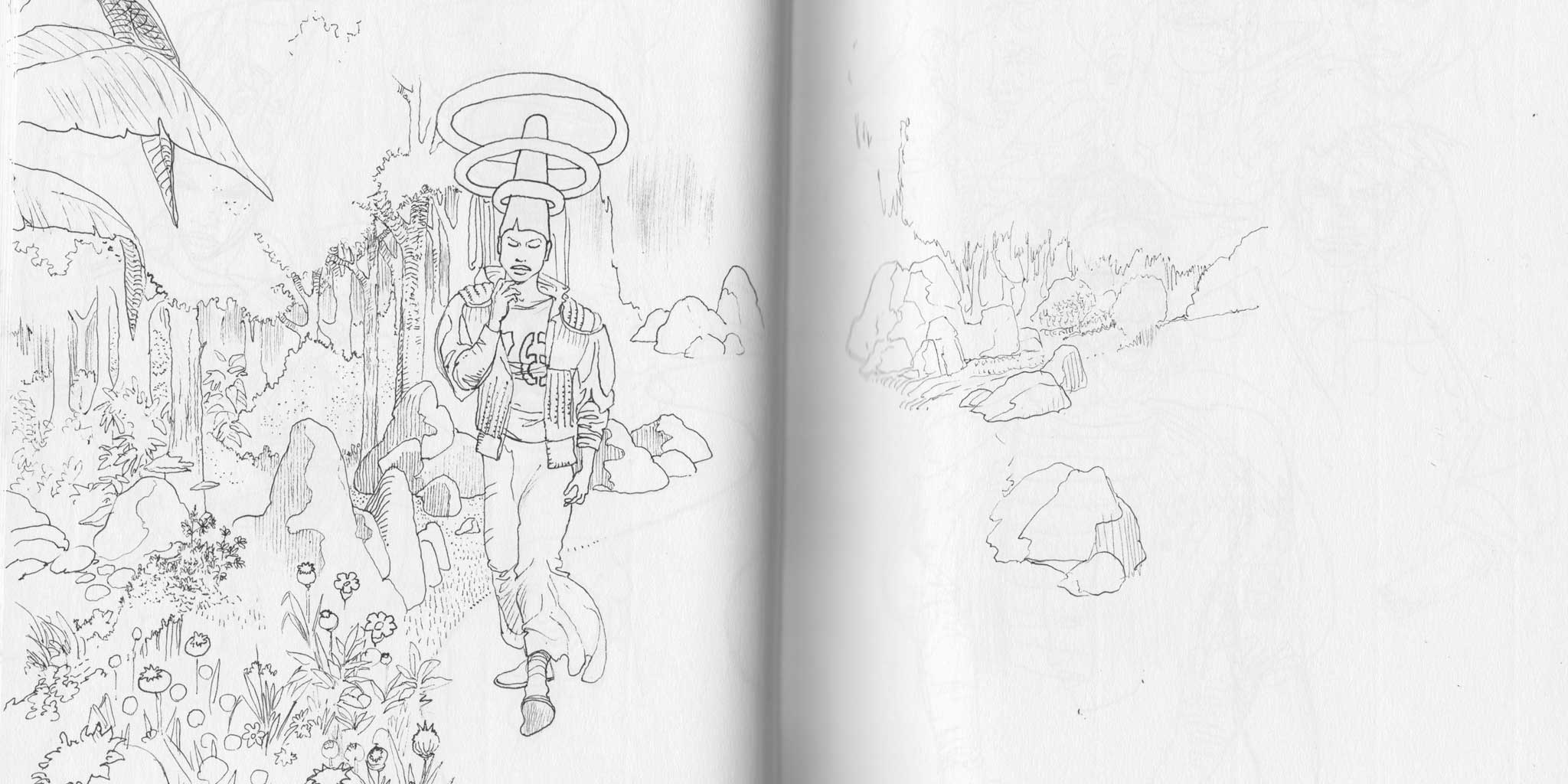
<p><a href="/images/sketchbook.jpg"><img src="/images/sketchbook-800-f49df894a.jpg" alt="From sketchbook" srcset="/images/sketchbook-400-f49df894a.jpg 400w, /images/sketchbook-600-f49df894a.jpg 600w, /images/sketchbook-800-f49df894a.jpg 800w, /images/sketchbook-1000-f49df894a.jpg 1000w"></a></p>
<figcaption>From sketchbook</figcaption>

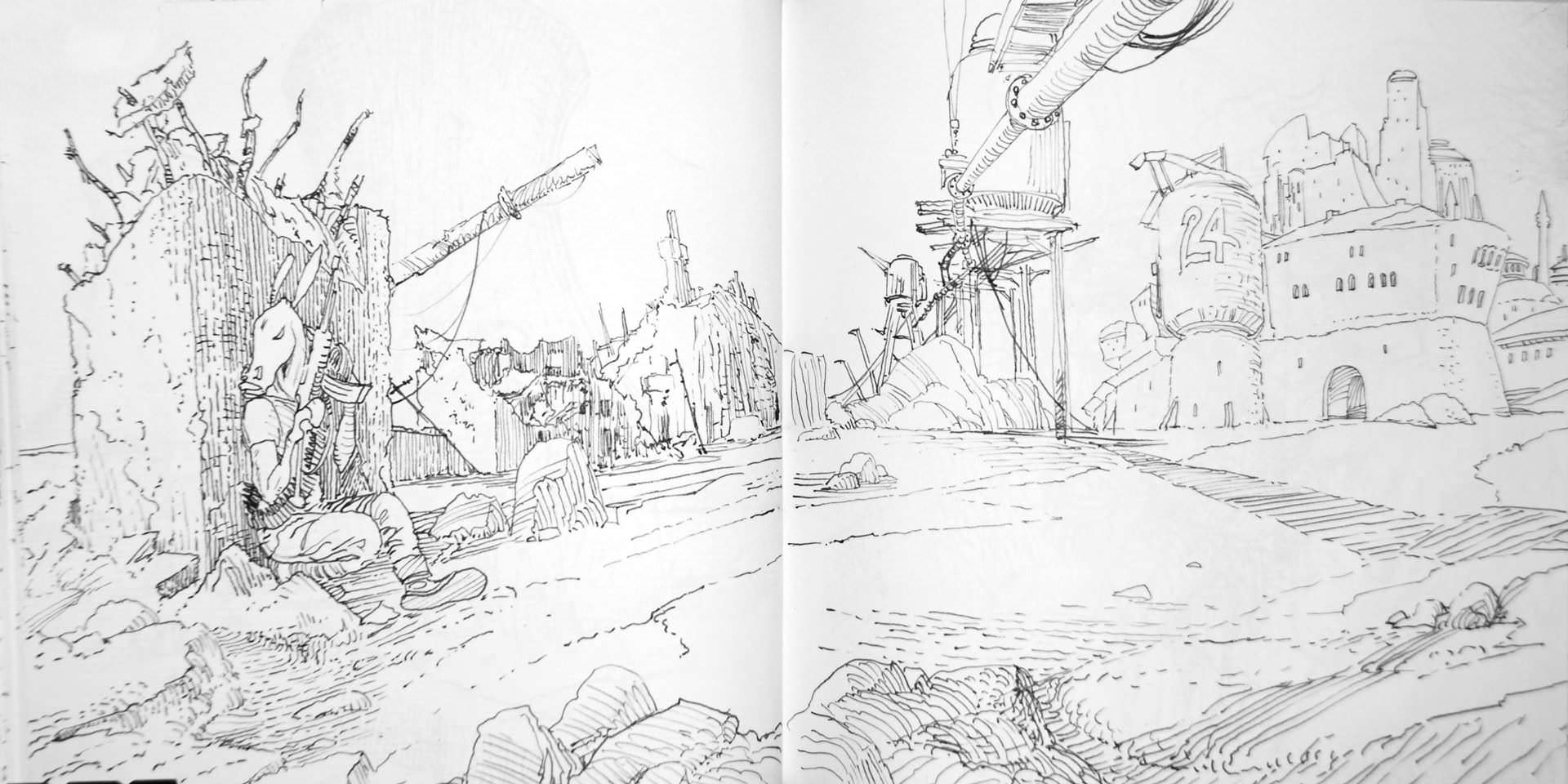
<p><a href="/images/Guerre-des-Anes_sketch.jpg"><img src="/images/Guerre-des-Anes_sketch-800-0a860c4ee.jpg" alt="La Guerre des Ânes" srcset="/images/Guerre-des-Anes_sketch-400-0a860c4ee.jpg 400w, /images/Guerre-des-Anes_sketch-600-0a860c4ee.jpg 600w, /images/Guerre-des-Anes_sketch-800-0a860c4ee.jpg 800w, /images/Guerre-des-Anes_sketch-1000-0a860c4ee.jpg 1000w"></a></p>
<figcaption>الحكايات الصامتة — sketchbook</figcaption>

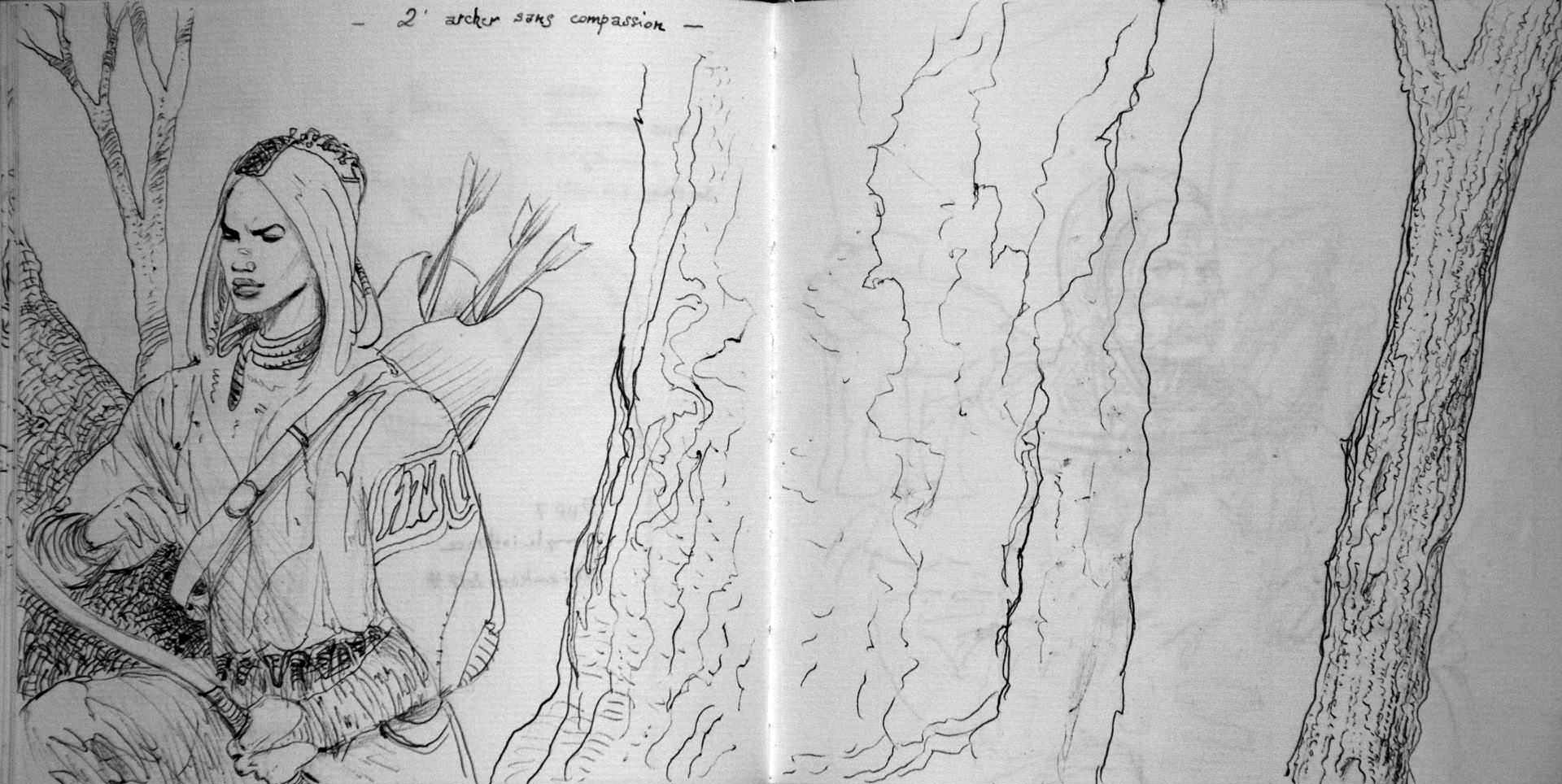
<p><a href="/images/archer.jpg"><img src="/images/archer-800-e0705b2fd.jpg" alt="L’archer sans compassion" srcset="/images/archer-400-e0705b2fd.jpg 400w, /images/archer-600-e0705b2fd.jpg 600w, /images/archer-800-e0705b2fd.jpg 800w, /images/archer-1000-e0705b2fd.jpg 1000w"></a></p>
<figcaption>Compassionless Archer — sketchbook</figcaption>]]></content><author><name>SILENT COMICS</name><uri>https://silent-comics.com</uri></author><category term="[&quot;drawing&quot;]" /><summary type="html"><![CDATA[This is the draughtsman doctrine.]]></summary></entry><entry><title type="html">Call For Translations</title><link href="https://log.silentcomics.com/languages/Call-for-Translations/" rel="alternate" type="text/html" title="Call For Translations" /><published>2014-01-13T00:00:00+00:00</published><updated>2014-01-13T00:00:00+00:00</updated><id>https://log.silentcomics.com/languages/Call-for-Translations</id><content type="html" xml:base="https://log.silentcomics.com/languages/Call-for-Translations/"><![CDATA[<section class="flex fr w-100 w-third-l">

<aside class="sidebar__right ph1 fr-ns">
<nav class="toc">
      <header><div class="nav__title b pa3 tc"><i class="fas fa-tasks"></i> Call for translations</div></header>
<ul class="toc__menu" id="markdown-toc">
  <li><a href="#the-brief" id="markdown-toc-the-brief">The Brief</a></li>
  <li><a href="#list-of-languages" id="markdown-toc-list-of-languages">List of languages</a>    <ul>
      <li><a href="#a" id="markdown-toc-a">A</a></li>
      <li><a href="#b" id="markdown-toc-b">B</a></li>
      <li><a href="#c" id="markdown-toc-c">C</a></li>
      <li><a href="#d" id="markdown-toc-d">D</a></li>
      <li><a href="#e" id="markdown-toc-e">E</a></li>
      <li><a href="#f" id="markdown-toc-f">F</a></li>
      <li><a href="#g" id="markdown-toc-g">G</a></li>
      <li><a href="#h" id="markdown-toc-h">H</a></li>
      <li><a href="#i" id="markdown-toc-i">I</a></li>
      <li><a href="#j" id="markdown-toc-j">J</a></li>
      <li><a href="#k" id="markdown-toc-k">K</a></li>
      <li><a href="#l" id="markdown-toc-l">L</a></li>
      <li><a href="#m" id="markdown-toc-m">M</a></li>
      <li><a href="#n" id="markdown-toc-n">N</a></li>
      <li><a href="#o" id="markdown-toc-o">O</a></li>
      <li><a href="#p" id="markdown-toc-p">P</a></li>
      <li><a href="#q" id="markdown-toc-q">Q</a></li>
      <li><a href="#r" id="markdown-toc-r">R</a></li>
      <li><a href="#s" id="markdown-toc-s">S</a></li>
      <li><a href="#t" id="markdown-toc-t">T</a></li>
      <li><a href="#u" id="markdown-toc-u">U</a></li>
      <li><a href="#v" id="markdown-toc-v">V</a></li>
      <li><a href="#x" id="markdown-toc-x">X</a></li>
      <li><a href="#y" id="markdown-toc-y">Y</a></li>
      <li><a href="#z" id="markdown-toc-z">Z</a></li>
    </ul>
  </li>
  <li><a href="#existing-translations" id="markdown-toc-existing-translations">Existing translations:</a></li>
  <li><a href="#thanks" id="markdown-toc-thanks">Thanks</a></li>
</ul>

    </nav>
</aside>

</section>

<p>Silent Comics are for everyone, regardless of their language and country of origin. Images are universal and need no translation. Except for the title. Translating the series title would help the project break the language barrier even further. In this spirit, this is a call for native speakers to translate “Silent Comics” in their language.</p>

<p>Want to help to translate these two words in your native tongue? Please send a line to hoa / at / silent-comics / dot / com or a tweet to <a href="https://twitter.com/SilentComics">@SilentComics</a>.</p>

<h2 id="the-brief">The Brief</h2>

<p>In English, the name <em>SILENT COMICS</em> is more or less self-explanatory. It draws a parallel with <em>silent films</em> so we understand at once that it is either about wordless comic book stories or maybe even about mime. The main idea here is returning to a simpler form than what comics have become. Going back to the original simplicity of the medium as a visual narrative. Without text<sup id="fnref:1" role="doc-noteref"><a href="#fn:1" class="footnote" rel="footnote">1</a></sup>, without dialogues, just pictures in sequences.</p>

<p>The long tradition of picture books from the origin of comics and before is also an inspiration. Hokusai <em>Manga</em>, in Japan, then Rodolphe Töpffer’s <em>Estampes</em>, in Europe and German wordless novels during the 20’ and 30’.</p>

<p>How would this idea translates in your native language?</p>

<p>The title’s translation doesn’t have to be literal. But it should convey the same feel it has in English, and it should sound pleasing.</p>

<h2 id="list-of-languages">List of languages</h2>

<p>Translations are welcome for the following languages (pick yours):</p>

<h3 id="a">A</h3>

<p><strong>Abkhazian</strong>, <strong>Afrikaans</strong>, <strong>Albanian</strong>, <strong>Amharic</strong>, Arabic: الحكايات الصامتة
 <strong>Armenian</strong>, <strong>Aymara</strong>, <strong>Azerbaijani</strong></p>

<h3 id="b">B</h3>

<p><strong>Belarusian</strong>, <strong>Bengali</strong>, <strong>Berber</strong>, <strong>Bislama</strong>, <strong>Bosnian</strong>, <strong>Bulgarian</strong>, <strong>Burmese</strong></p>

<h3 id="c">C</h3>
<p><strong>Cantonese</strong>, <strong>Catalan</strong>, <strong>Chinese Mandarin</strong>, <strong>Chichewa</strong>, <strong>Croatian</strong>, <strong>Czech</strong></p>

<h3 id="d">D</h3>

<p><strong>Danish</strong>, <strong>Dari</strong>, <strong>Dhivehi</strong>, <strong>Dutch</strong>, <strong>Dzongkha</strong></p>

<h3 id="e">E</h3>
<p>English: <em>SILENT COMICS</em>, <strong>Estonian</strong></p>

<h3 id="f">F</h3>

<p><strong>Fijian</strong>, <strong>Filipino</strong>, <strong>Finnish</strong>, French:</p>

<ul>
  <li><em>“Bande Dessinée Muette”</em></li>
  <li><em>”BD Muette”</em></li>
  <li><em>”BD Silencieuses”</em></li>
</ul>

<h3 id="g">G</h3>
<p><strong>Georgian</strong>, German: <em>Stummcomic</em>, <strong>Greek</strong>, <strong>Guaraní</strong></p>

<h3 id="h">H</h3>
<p><strong>Haitian Creole</strong>, <strong>Hausa</strong>, <strong>Hebrew</strong>, <strong>Hindi</strong>, <strong>Hiri Motu</strong>, <strong>Hungarian</strong></p>

<h3 id="i">I</h3>

<p><strong>Ibo</strong>, <strong>Icelandic</strong>, <strong>Indonesian</strong>, <strong>Irish</strong>, <strong>Italian</strong></p>

<h3 id="j">J</h3>

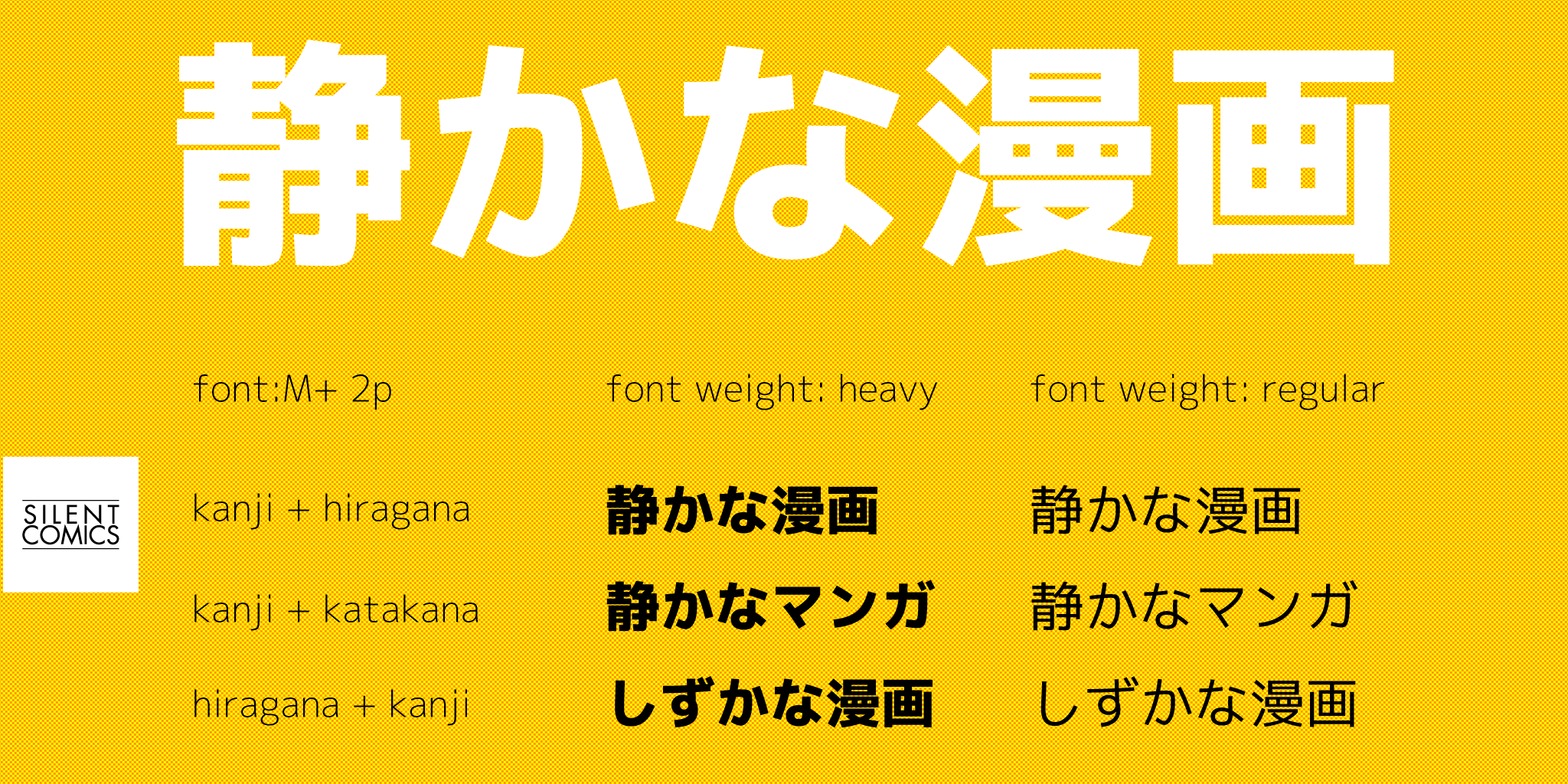
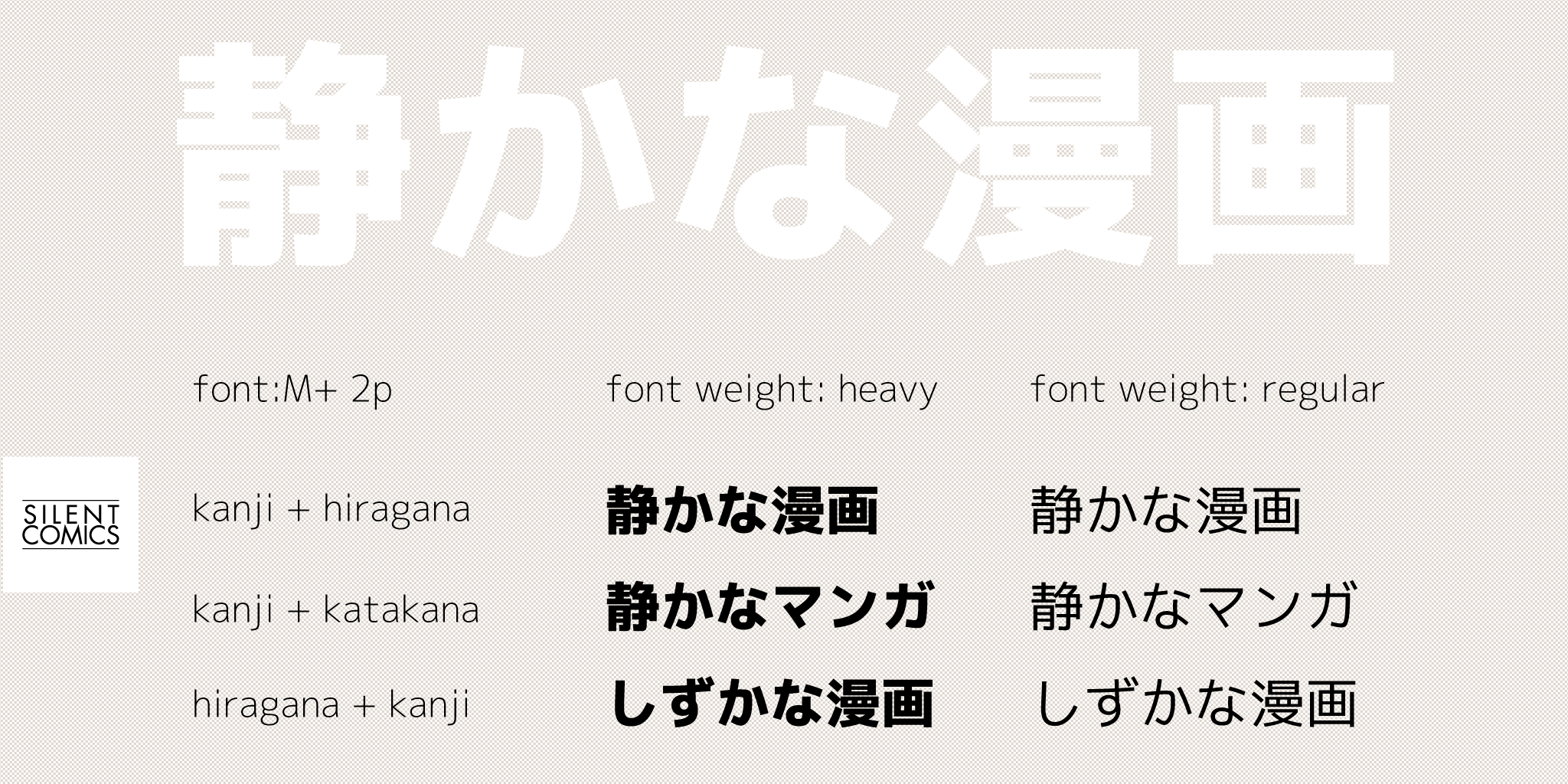
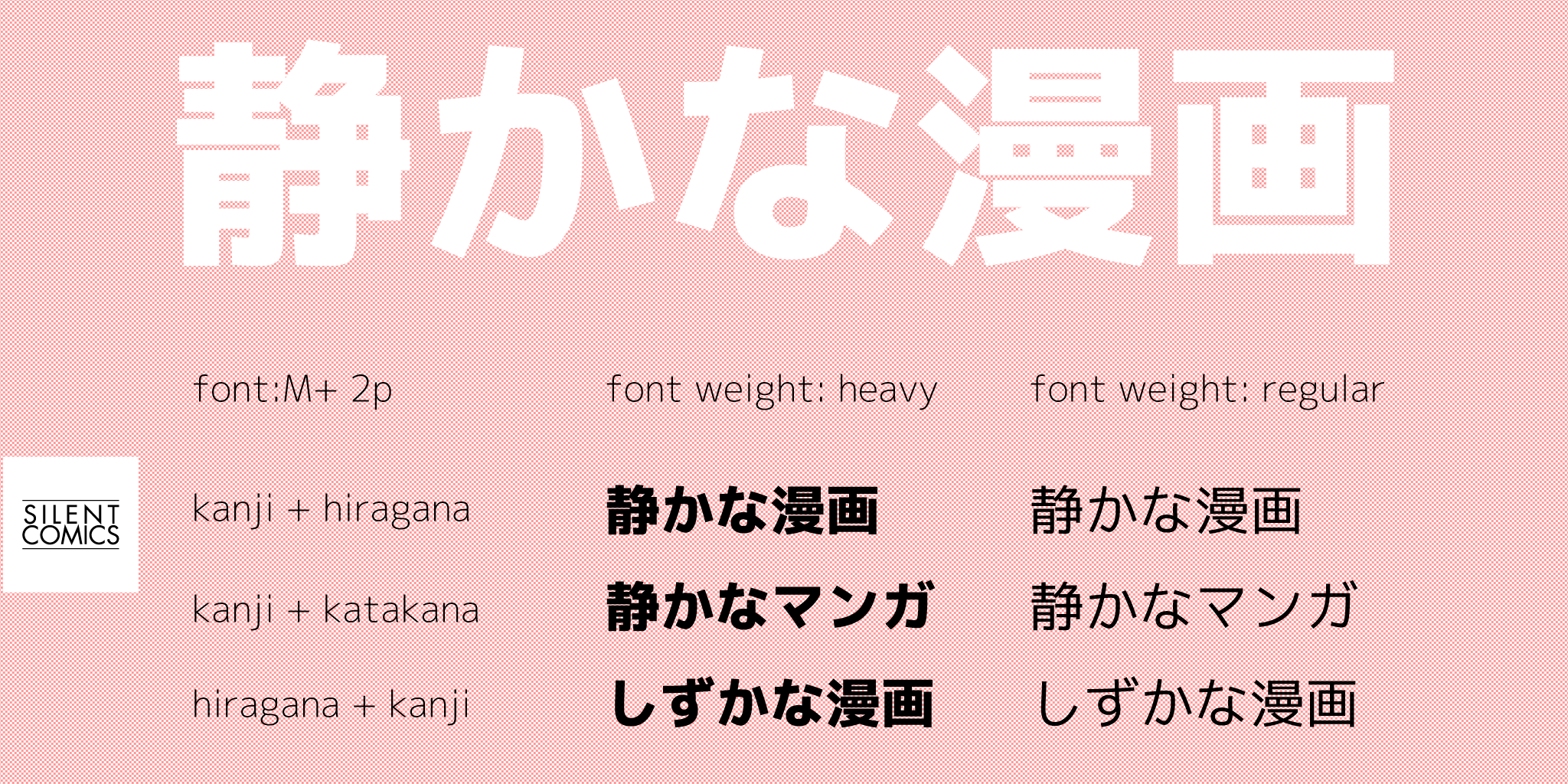
<p>Japanese:</p>

<ul>
  <li>
    <p>kanji + hiragana 静かな漫画</p>
  </li>
  <li>
    <p>Kanji + katakana 静かなマンガ</p>
  </li>
  <li>
    <p>hiragana + kanji しずかな漫画</p>
  </li>
</ul>

<h3 id="k">K</h3>

<p><strong>Kazakh</strong>, <strong>Khmer</strong>, <strong>Kinyarwanda</strong>, <strong>Kikongo</strong>, <strong>Kirundi</strong>, <strong>Kituba</strong>, <strong>Korean</strong>, <strong>Kurdish</strong>, <strong>Kyrgyz</strong></p>

<h3 id="l">L</h3>

<p><strong>Lao</strong>, <strong>Latin</strong>, <strong>Latvian</strong>, <strong>Lingala</strong>, <strong>Lithuanian</strong>, <strong>Luxembourgish</strong></p>

<h3 id="m">M</h3>
<p><strong>Macedonian</strong>, <strong>Malagasy</strong>, <strong>Malay</strong>, <strong>Maltese</strong>, <strong>Manx Gaelic</strong>, <strong>Māori</strong>, <strong>Moldovan</strong>, <strong>Mongolian</strong>, <strong>Montenegrin</strong></p>

<h3 id="n">N</h3>

<p><strong>Ndebele</strong>, <strong>Nepali</strong>, <strong>New Zealand Sign Language</strong>, <strong>Northern Sotho</strong>, <strong>Norwegian</strong></p>

<h3 id="o">O</h3>

<p><strong>Ossetian</strong></p>

<h3 id="p">P</h3>

<p><strong>Punjabi</strong>, <strong>Papiamento</strong>, <strong>Pashtu</strong>, <strong>Persian</strong>, <strong>Polish</strong>, Portuguese: <em>QUADRINHOS SILENCIOSOS</em></p>

<h3 id="q">Q</h3>

<p><strong>Quechua</strong></p>

<h3 id="r">R</h3>
<p><strong>Romanian</strong>, <strong>Romansh</strong>, <strong>Russian</strong></p>

<h3 id="s">S</h3>

<p><strong>Sango</strong>, <strong>Serbian</strong>, <strong>Seychellois Creole</strong>, <strong>Shona</strong>, <strong>Sinhala</strong>, <strong>Slovak</strong>, <strong>Slovene</strong>, <strong>Somali</strong>, <strong>Sotho</strong>, <strong>Spanish</strong>, <strong>Swahili</strong>, <strong>Swati</strong>, <strong>Swedish</strong></p>

<h3 id="t">T</h3>

<p><strong>Tajik</strong>, <strong>Tagalog</strong>, <strong>Tamil</strong>, <strong>Tetum</strong>, <strong>Thai</strong>, <strong>Tigrinya</strong>, <strong>Tok Pisin</strong>, <strong>Tshiluba</strong>, <strong>Tsonga</strong>, <strong>Tswana</strong>, <strong>Turkish</strong>, <strong>Turkmen</strong></p>

<h3 id="u">U</h3>

<p><strong>Ukrainian</strong>, <strong>Urdu</strong>, <strong>Uzbek</strong></p>

<h3 id="v">V</h3>

<p><strong>Venda</strong>, Vietnamese: Truyện tranh câm (?)<sup id="fnref:2" role="doc-noteref"><a href="#fn:2" class="footnote" rel="footnote">2</a></sup></p>

<h3 id="x">X</h3>

<p><strong>Xhosa</strong></p>

<h3 id="y">Y</h3>

<p><strong>Yoruba</strong></p>

<h3 id="z">Z</h3>

<p><strong>Zulu</strong></p>

<p><small>source — <a href="http://en.wikipedia.org/wiki/List_of_official_languages">List of official languages</a> - Wikipedia</small></p>

<p class="notice"><em>Found your language missing? Want to improve upon or suggest an alternative translation? Get in touch with <a href="https://twitter.com/SilentComics">@SilentComics</a> or send a line to hoa / at / silent-comics / dot / com.</em></p>

<h2 id="existing-translations">Existing translations:</h2>

<p><em>English</em>, <em>Arabic</em>, <em>Japanese</em>, <em>German</em>, <em>French</em> (could be improved?), <em>Portuguese</em></p>

<figure>
	<a href="/images/Silent-Comics_English.png"><img src="/images/Silent-Comics_English.png" /></a>
	<figcaption>SILENT COMICS script</figcaption>
</figure>

<figure class="half">
	<a href="/images/Silent-Comics_Arabic_01.png"><img src="/images/Silent-Comics_Arabic_01.png" /></a>
	<a href="/images/Silent-Comics_Arabic_02.png"><img src="/images/Silent-Comics_Arabic_02.png" /></a>
	<figcaption>Translated into Arabic</figcaption>
</figure>

<figure class="third">
	<a href="/images/Silent-Comics_Jp.png"><img src="/images/Silent-Comics_Jp.png" /></a>
	<a href="/images/Silent-Comics_Jp_grey.png"><img src="/images/Silent-Comics_Jp_grey.png" /></a>
  <a href="/images/Silent-Comics_Jp_pink.png"><img src="/images/Silent-Comics_Jp_pink.png" /></a>
	<figcaption>Japanese translations</figcaption>
</figure>

<p class="notice">Samples above use <a href="http://mplus-fonts.sourceforge.jp">M+ fonts</a>.</p>

<h2 id="thanks">Thanks</h2>
<p>Warm <em>Thank You</em> to Soraya, Yoshihiro and Andre for their help translating <em>Silent Comics</em> into Arabic, Japanese and Portuguese. You are most kind!</p>
<div class="footnotes" role="doc-endnotes">
  <ol>
    <li id="fn:1" role="doc-endnote">
      <p>See the SILENT COMICS <a href="/manifesto">manifesto</a>. <a href="#fnref:1" class="reversefootnote" role="doc-backlink">&#8617;</a></p>
    </li>
    <li id="fn:2" role="doc-endnote">
      <p>My own tentative Vietnamese translation, please improve if you are a native Vietnamese speaker 😀 <a href="#fnref:2" class="reversefootnote" role="doc-backlink">&#8617;</a></p>
    </li>
  </ol>
</div>]]></content><author><name>SILENT COMICS</name><uri>https://silent-comics.com</uri></author><category term="[&quot;languages&quot;]" /><category term="translation" /><summary type="html"><![CDATA[SILENT COMICS: an open call for translation.]]></summary></entry><entry><title type="html">The Wake of SILENT COMICS</title><link href="https://log.silentcomics.com/the-wake-of-silent-comics/" rel="alternate" type="text/html" title="The Wake of SILENT COMICS" /><published>2013-06-19T00:00:00+00:00</published><updated>2013-06-19T00:00:00+00:00</updated><id>https://log.silentcomics.com/the-wake-of-silent-comics</id><content type="html" xml:base="https://log.silentcomics.com/the-wake-of-silent-comics/"><![CDATA[<p class="notice">Quick notes before launch. <a href="https://silent-comics.com">SILENT COMICS</a> is a personal attempt to simplify reading comics on screens as an alternative to cluttered webcomics.</p>

<h3 id="how-can-you-make-reading-comics-easier">How can you make reading comics easier?</h3>

<p>First, let’s skip the <em>reading</em> part. Strip the strips of text. Remove speech bubbles. Why read comics that you can just <em>watch</em>?</p>

<p>Second, use a simple grid.</p>

<p>Last, don’t be afraid of <a href="https://en.wikipedia.org/wiki/Decompression_(comics)"><em>decompression</em></a>.</p>

<h3 id="simple-constraints">Simple constraints</h3>

<ul>
  <li>no text</li>
  <li>a single ratio panel format</li>
  <li>long-form divided into small episodes</li>
</ul>

<h3 id="panel-to-panel-reading">Panel to panel reading</h3>
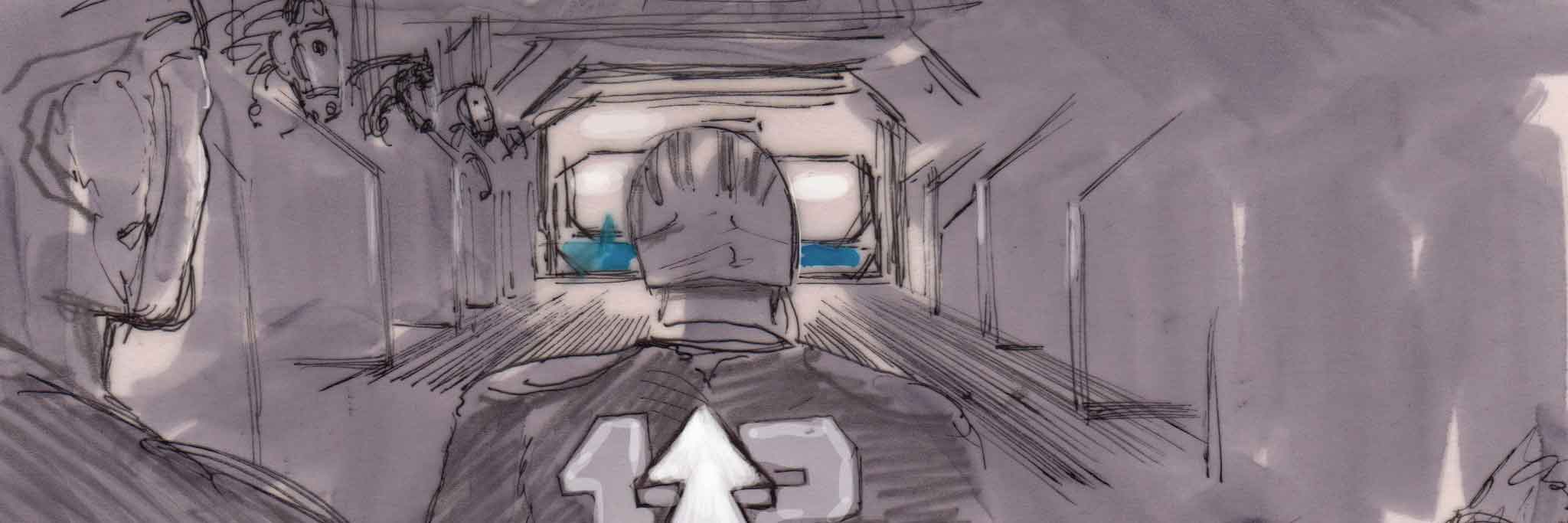
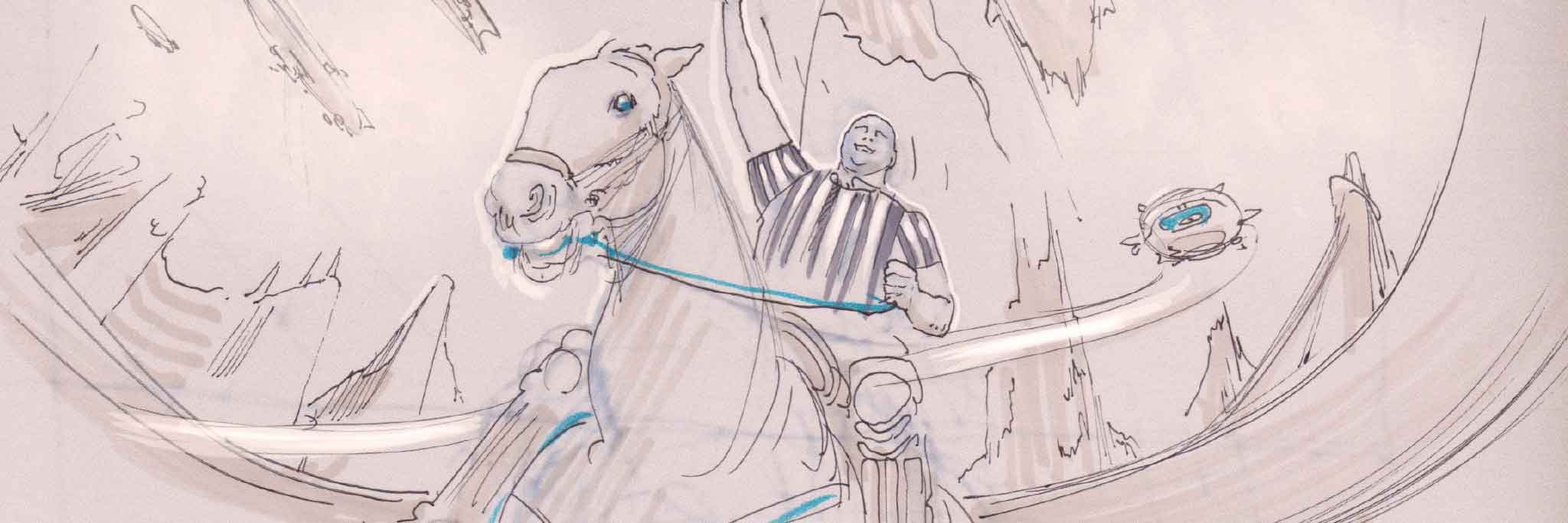
<p class="notice">Here is how this could work: click on an image in full screen to watch. You can either use touch gesture or keyboard navigation <sup id="fnref:1" role="doc-noteref"><a href="#fn:1" class="footnote" rel="footnote">1</a></sup>.</p>

<section id="demo-gallery" class="gallery" itemscope="" itemtype="http://schema.org/ImageGallery">

<a href="https://log.silentcomics.com/images/silentcomics_featured_ratio-2X1.png" data-size="2048x1024" data-med="https://log.silentcomics.com/images/silentcomics_featured_ratio-2X1.png" data-med-size="1024x728" data-author="SILENT COMICS">
  <img src="https://log.silentcomics.com/images/silentcomics_featured_ratio-2X1.png" alt="" />
  <figcaption>Cover</figcaption>
</a>

<a href="https://log.silentcomics.com/images/comic-panel-00.jpg" data-size="2048x683" data-med="https://log.silentcomics.com/images/comic-panel-00.jpg" data-med-size="1024x341" data-author="SILENT COMICS">
  <img src="https://log.silentcomics.com/images/comic-panel-00.jpg" alt="" />
  <figcaption>Panel 1</figcaption>
</a>

<a href="/images/comic-panel-01.jpg" data-size="2048x683" data-med="/images/comic-panel-01.jpg" data-med-size="1024x341" data-author="SILENT COMICS">
  <img src="/images/comic-panel-01.jpg" alt="" />
  <figcaption>Panel 2</figcaption>
</a>

<a href="/images/comic-panel-02.jpg" data-size="2048x683" data-med="/images/comic-panel-02.jpg" data-med-size="1024x341" data-author="SILENT COMICS">
  <img src="/images/comic-panel-02.jpg" alt="" />
  <figcaption>Panel 3</figcaption>
</a>

<a href="/images/comic-panel-03.jpg" data-size="2048x683" data-med="/images/comic-panel-03.jpg" data-med-size="1024x341" data-author="SILENT COMICS">
  <img src="/images/comic-panel-03.jpg" alt="" />
  <figcaption>Panel 4</figcaption>
</a>

<a href="/images/comic-panel-04.jpg" data-size="2048x683" data-med="/images/comic-panel-04.jpg" data-med-size="1024x341" data-author="SILENT COMICS">
  <img src="/images/comic-panel-04.jpg" alt="" />
  <figcaption>Panel 5</figcaption>
</a>

</section>

<div><a href="http://issuu.com/alternatyves/docs/fatal_trope_in_the_tzykanisterion?e=1029923/5498472" class="btn btn--inverse align-right"> Check out 12 pages storyboard of Silent Comics issue #00</a></div>
<p><small>…to be continued</small></p>

<h3 id="why-do-we-need-this">Why do we need this?</h3>
<p>SILENT COMICS celebrate the return of a simple form, drawing inspiration from silent films as well as from the origins of the comic-book medium.</p>

<p>Today in the digital age, wordless comics present an opportunity to re-explore the format<sup id="fnref:2" role="doc-noteref"><a href="#fn:2" class="footnote" rel="footnote">2</a></sup> as a visual-only narrative, and revisit the roots of a genre that started with picture books, perhaps even earlier, wherever comics-strips originated from<sup id="fnref:3" role="doc-noteref"><a href="#fn:3" class="footnote" rel="footnote">3</a></sup>.</p>

<h3 id="definitions">Definitions</h3>
<p>Sometimes going back to definitions help us realize things were not exactly what we thought they were. In turn, the origin of a word can also inspire new ideas.</p>

<blockquote>
  <p><strong>silent</strong> |ˈsʌɪlənt|
adjective
not making or accompanied by any sound: <em>the wood was still and silent.</em>
• (of a person) not speaking: <em>she fell silent for a moment.</em>
• not expressed aloud: <em>a silent prayer.</em>
• (of a letter) written but not pronounced, e.g. b in <em>doubt. a silent ‘h’.</em>
• (of a film) without an accompanying soundtrack. <em>she appeared in a number of silent films.</em>
• saying or recording nothing on a particular subject: <em>the poems are silent on the question of marriage.</em>
• (of a person) not prone to speak much; taciturn: <em>I’m the strong, silent type.</em>
PHRASES
<strong>( as ) silent as the grave</strong> see grave.
<strong>the silent majority</strong> the majority of people, regarded as holding moderate opinions but rarely expressing them.
<strong>the silent treatment</strong> a stubborn refusal to talk to someone, especially after a recent argument or disagreement.
DERIVATIVES
<strong>silently</strong> adverb
ORIGIN late 15th cent. (in the sense ‘not speaking’): from Latin <strong><em>silent- ‘being silent’</em></strong>, from the verb <strong><em>silere</em></strong>.</p>
</blockquote>

<p class="notice">✓ check.</p>

<hr />

<blockquote>
  <p><strong>comic</strong> |ˈkɒmɪk|
adjective
causing or meant to cause laughter: a comic monologue.
• relating to or in the style of comedy: a comic actor | comic drama.
noun
1 a comedian.
2 a periodical containing comic strips, intended chiefly for children.
• (comics) N. Amer.comic strips.
ORIGIN late 16th cent.: via Latin from Greek kōmikos, from kōmos ‘revel’.</p>
</blockquote>

<hr />

<p class="notice">“Revel” sounds promising! Lets take a look at what it means:</p>

<blockquote>
  <p><strong>revel</strong> |ˈrɛv(ə)l|
verb (<strong>revels, revelling, revelled;</strong> US <strong>revels, reveling, reveled</strong>) [ no obj. ]
enjoy oneself in a lively and noisy way, especially with drinking and dancing: (as noun <strong>revelling</strong>) : <em>a night of drunken revelling.</em>
• (<strong>revel in</strong>) gain great pleasure from (a situation): Bill said he was secretly revelling in his new-found fame.
noun (<strong>revels</strong>)
lively and noisy enjoyment, especially with drinking and dancing.
ORIGIN late Middle English: from Old French <strong>reveler ‘rise up in rebellion’</strong>, from Latin <strong>rebellare ‘to rebel’.</strong></p>
</blockquote>

<hr />

<p class="notice">There is indeed a healthy association between comedy and rebellion. This shows in the history of comics, from their infancy to their heyday.</p>

<blockquote>
  <p><strong>comic strip</strong>
noun
a sequence of drawings in boxes that tell an amusing story, typically printed in a newspaper or magazine.</p>
</blockquote>

<p class="notice">Note that this definition excludes drama.</p>

<div class="footnotes" role="doc-endnotes">
  <ol>
    <li id="fn:1" role="doc-endnote">
      <p>The gallery is an implementation of <a href="https://photoswipe.com/">Photoswipe</a> developed by <a href="http://dimsemenov.com">Dmitry Semenov</a>. <a href="#fnref:1" class="reversefootnote" role="doc-backlink">&#8617;</a></p>
    </li>
    <li id="fn:2" role="doc-endnote">
      <p>Not merely transposing the comic page from paper to screen but taking advantage of the electronic form’s own possibilities and limitations. <a href="#fnref:2" class="reversefootnote" role="doc-backlink">&#8617;</a></p>
    </li>
    <li id="fn:3" role="doc-endnote">
      <p>Leave it to scholars to determine whether The Lascaux caves were or weren’t sequential, and whether hieroglyphs from Egypt, the Trajan column, Ars moriendi, Hokusai Manga, or Rodolphe Töpffer were indeed the precursors of a tradition that led to Arzach. <a href="#fnref:3" class="reversefootnote" role="doc-backlink">&#8617;</a></p>
    </li>
  </ol>
</div>]]></content><author><name>SILENT COMICS</name><uri>https://silent-comics.com</uri></author><category term="webcomics" /><category term="ideas" /><summary type="html"><![CDATA[Kick-off: The Wake of SILENT COMICS.]]></summary></entry></feed>